
Robot Training Data / EGO R9 Field Notes / Aug 19, 2026
From Human Demonstrations to Safer Autonomy: High-Fidelity First-Person Data with EGO R9
Robots learn physical work best from data that preserves what a skilled person sees, how the hands move, and when each decision occurs. EGO R9 provides a practical first-person capture layer for building that evidence at scale.
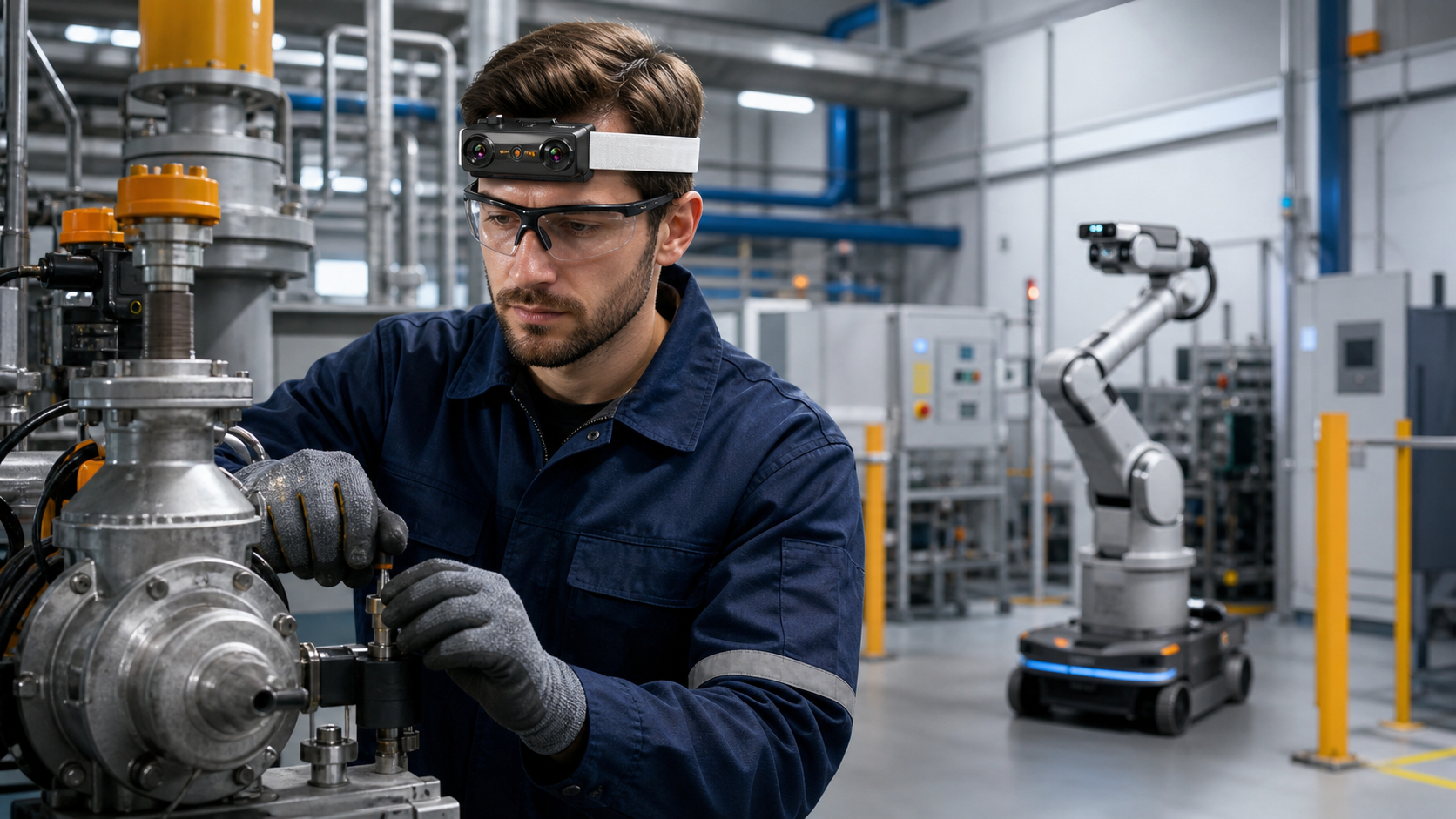
Robotic autonomy is moving from controlled demonstrations toward factories, infrastructure sites, logistics facilities, and other environments where machines must perceive and act under real-world variation. Stronger models and better hardware are essential, but neither can compensate for training data that misses the viewpoint, timing, and hand-object detail of the work a robot is expected to perform.
Egocentric vision addresses that gap by recording from the operator's natural point of view. It can preserve the relationship among hands, tools, objects, workspace geometry, and the visual cues that cause an experienced worker to pause, adjust, verify, or recover.
That perspective matters because many deployed robots also perceive the world through body-mounted sensors. Third-person footage remains useful for body pose, scene context, and supervision, but it often hides close manipulation behind the operator or equipment. First-person data complements those views with the near-field evidence needed for object recognition, action segmentation, spatial reasoning, and imitation-learning research.
The EGO R9 is designed as a hands-free capture layer for this upstream data-collection work. Its 120-degree wide-angle view helps retain both hands and the surrounding workspace, while 1080P global-shutter video is suited to motion-rich tasks where distortion can obscure tool approach or object state. A 6-axis IMU sampling above 200 Hz records head motion alongside the video.
Shared clock support and global timestamps place R9's visual and inertial records on one time basis. This helps a dataset distinguish preparation, approach, contact, manipulation, inspection, and completion as separate observable stages.
A useful collection program should include different operators, workspaces, object variants, lighting conditions, task speeds, and ordinary recovery behaviors while keeping capture settings and metadata consistent. Teams should define task boundaries, hand-visibility requirements, sensor configuration, acceptance criteria, and quality review before expanding from a pilot to thousands of hours.
The safety opportunity is especially important in high-risk work. Demonstrations from qualified people can help researchers study inspection, material handling, maintenance, confined-space assessment, and other procedures that may eventually be assisted or performed by robots. The goal is to transfer human operational knowledge without treating workers as disposable sources of footage or asking anyone to repeat an unsafe action for the camera.
Any field program must therefore begin with site approval, informed participation, required PPE, exclusion zones, privacy controls, access rules, and the worker's unrestricted ability to stop recording. Proprietary displays, bystanders, personal information, and sensitive locations should be minimized or de-identified.
Calibration, curation, task segmentation, annotation, privacy filtering, embodiment alignment, model training, simulation or controlled testing. Its role is to provide consistent first-person visual and motion evidence with the fidelity needed for those stages to begin from stronger source material.
As autonomous systems take on more physically demanding work, the quality of their human demonstrations will shape how reliably they understand objects, sequence actions, and respond to change. By capturing skilled work from the viewpoint where perception meets action, EGO R9 helps create the data bridge between human experience and robots designed to operate more safely in the real world.