
Robot Learning / Zipper Manipulation / Original EGO R9 application guide; EgoDex research task list / Oct 16, 2026
Egocentric Video for Robot Learning: Zipper Tasks with R9
Record egocentric video for robot learning with EGO R9: a zipper-handling workflow using 1080P global-shutter capture, a 120° view and shared timing.
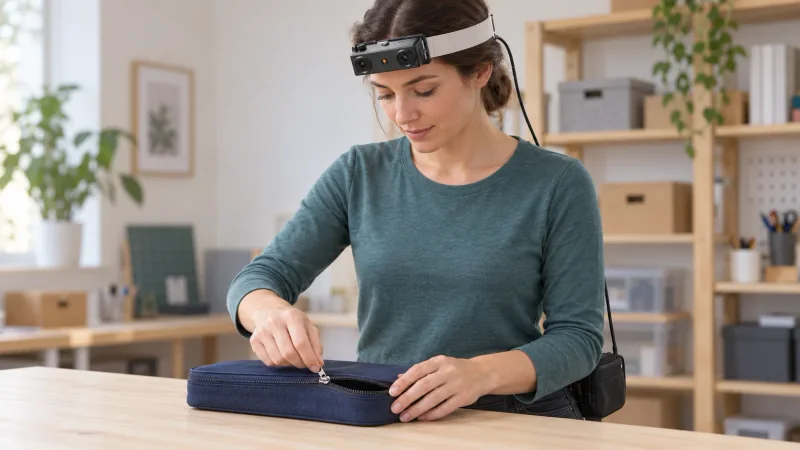
How can R9 record zipper demonstrations for robot learning?
- R9 records 1080P global-shutter video at 30 FPS; 60 FPS is an optional configuration.
- The 120° lens and adjustable camera angle let the team set up a view of both hands, the zipper pull and the case.
- A 6-axis IMU above 200 Hz, shared-clock support and global timestamps provide time-linked camera-motion information.
- Researchers review opening, closing and grip-change intervals and attach the task descriptions to the R9 recordings.
Explore EGO R9 specifications and manufacturer documentation
Egocentric video for robot learning can document a compact but coordinated task: opening and closing a zippered case while one hand steadies the fabric and the other moves the slider. EGO R9 records that interaction from a head-mounted viewpoint using 1080P global-shutter video at 30 FPS. This proposed R9 capture workflow focuses on the zipper pull, the supporting hand and the changing opening, with researchers defining the task descriptions and reviewing the recordings for their learning experiments.
A zipper task grounded in egocentric research
Apple's EgoDex research studies dexterous manipulation through egocentric video. Its published task list explicitly includes zipping and unzipping bags and cases, making this a documented application setting for first-person demonstration research. The guide below develops an R9 recording plan for those actions. The scene selection comes from the research task list; the camera specifications come from the supplied R9 manufacturer document and confirmed product page.
Record opening and closing as complete actions
Begin the R9 recording with the case resting on the table and the zipper's initial position visible. Demonstrate opening and closing as separately identified actions: one hand holds the case beside the track while the other takes the pull and moves it along the edge. Keep the final opening or closure visible before resetting the case. R9's head-mounted arrangement leaves both hands available for this coordinated movement and follows the operator's working viewpoint.
Frame the pull and the supporting hand
Use R9's adjustable camera angle and 120° wide-angle lens to frame the task at the actual table height. In a short pilot recording, inspect the near end of the zipper, the far end, the pulling hand and the stabilizing hand. A case can turn as the slider passes a corner, so check that part of the demonstration as well. Review the original image at the intended working distance and choose the case position that keeps the pull and surrounding fabric visible.
Choose the R9 video configuration
R9's standard 1080P, 30 FPS mode provides the video sequence for reviewing the pull's movement and the resulting change in the case opening. Its global shutter exposes the image pixels together within each frame. When the wearer follows the slider with a head movement, this capture characteristic is relevant to the recorded view of the zipper track and case edge. Record the selected video mode with the session; 60 FPS is an optional R9 configuration.
Keep grip changes in the recorded sequence
Keep any change of grip inside the R9 episode. If the demonstrator releases the pull, moves the supporting hand or rotates the case before continuing, retain the surrounding video so the sequence remains understandable. R9 supports global timestamps. Reviewers can use the original time references when marking the first contact with the pull, a grip change, the end of travel and the final visible state. These event labels are created by the collection team during review.
Retain the timing of viewpoint changes
R9 also provides a 6-axis IMU with a sampling rate above 200 Hz, together with shared-clock and global-timestamp support. Preserve these time references with the camera-unit motion record when the wearer looks between the zipper's ends. For this tabletop session, researchers can associate visible viewpoint changes with the recorded head-unit movement while examining an opening or closing interval. Keep the original timestamps when producing shorter review clips from a full take.
Prepare storage and power for repeated takes
For repeated zipper demonstrations, R9 supports T-Flash memory-card storage, H.265 video in an MP4 container and an external battery. Prepare the recording media and power arrangement before the session, keeping the cable clear of the hands and case. Play back a short recording to check the actual framing, then save each complete take under a session and case identifier. Retain the source MP4 files alongside the selected capture settings and time-linked review notes.
Connect each recording to its task description
A useful R9 record should make the demonstrated action easy to identify. The research team can attach concise instructions such as 'open the case' or 'close the case,' together with the initial zipper position and the reviewed action interval. If a second case or a different starting position is included, record that condition explicitly. Egocentric video for robot learning then remains linked to a defined human demonstration as the team prepares its annotations, training inputs and evaluation plan.
Research reference and R9 specifications
EgoDex paper — Appendix A.1, zipper tasks in the manipulation task list
Explore EGO R9 specifications and manufacturer documentation