
Fine-Grained Action Data / Original EGO R9 field guide informed by HD-EPIC / Sep 10, 2026
Every Step Counts: Annotation-Ready Kitchen Data with EGO R9
Opening a jar, weighing ingredients, and returning a lid are separate learning events. Inspired by HD-EPIC, this practical R9 guide shows how to capture continuous kitchen activity that reviewers can segment, verify, and reuse.
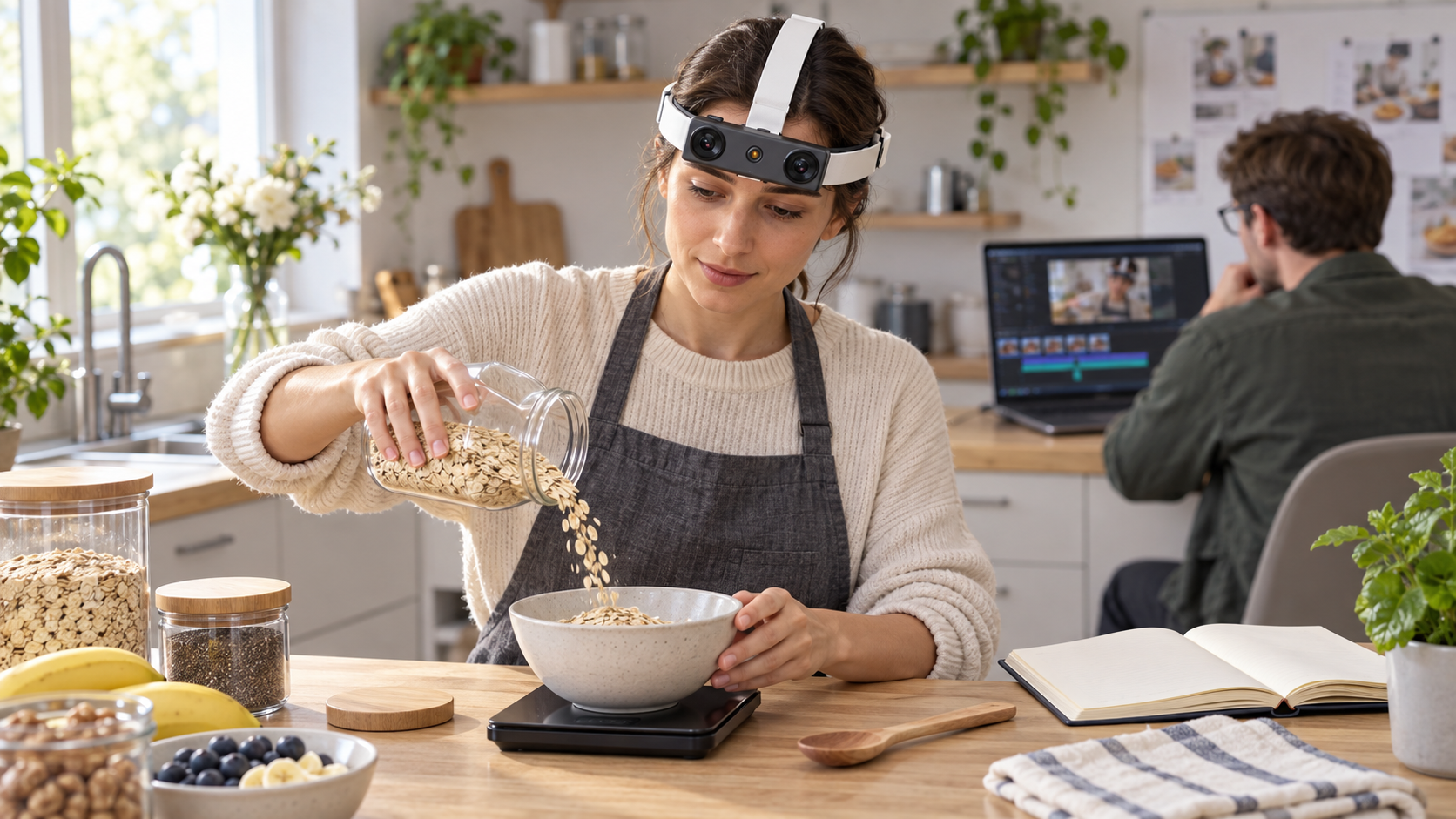
Preparing a bowl of oats looks like one task until someone has to label it. The participant retrieves a jar, opens its lid, positions a bowl, pours, checks the scale, adjusts the amount, closes the jar, and returns it to storage. Some actions overlap, and a short glance may explain a later correction. It is keeping the evidence needed to identify each action and connect it to the next.
HD-EPIC is a CVPR 2025 egocentric dataset built around detailed annotations of unscripted kitchen activity, including action boundaries, recipe structure, sound events, object movement, and richer spatial information. Its project page also describes gaze and digital-twin resources. Those outputs belong to the HD-EPIC collection and processing system.
Use a cold-meal preparation task for an initial study: retrieve a container, remove its lid, portion dry ingredients into a bowl on a scale, make a small correction, reseal the container, and clear the counter. Keep recording through pauses and return trips, since they explain object locations and task order. Vary container shape, dominant hand, counter layout, and participant height across sessions.
EGO R9's hands-free forehead position allows the participant to use both hands. Its 120-degree wide-angle lens can retain the active bowl, storage container, and nearby counter in one view, while the adjustable angle helps fit the working distance. Run a framing check before the recipe: lowest reach, lid removal, pour, scale inspection, and return to storage.
R9 provides 1080P global-shutter recording at 30 FPS, with 60 FPS and 1920 by 1200 available as separate optional configurations to confirm when ordering. For this pilot, inspect jar rotation, spoon movement, and the start and end of pouring under the actual room lighting. Global shutter avoids rolling-shutter skew during motion, but exposure blur, reflections, and a small scale display can still remove evidence. If a measured ingredient quantity matters, collect it in an approved external log rather than assuming the number will always be readable in the video.
Define the annotation contract before asking participants to record. Each segment should have a task identifier, object identifier, active hand, action name, start and end timestamps, visible outcome, and reviewer confidence. Preserve overlapping segments when one hand holds a bowl while the other pours. Store uncertainty instead of forcing an unsupported precise label.
R9's 6-axis IMU above 200 Hz provides head-motion context, while shared clock support and global timestamps help relate the video and inertial record. This is useful when a fast turn coincides with a brief loss of the work surface. Verify timestamp monotonicity, sample gaps, camera-stream correspondence, and segment-to-source alignment on the delivered configuration. Camera intrinsics support can assist a separately validated geometric workflow.
Microphone support adds another possible evidence channel when participants consent to audio capture. A lid click or spoken explanation may help a reviewer locate an event, but neither should be treated as unquestionable ground truth. Test whether relevant sounds are audible over ventilation and handling noise. Keep any after-session narration linked to its own time base, and distinguish the participant's stated intention from the visible result. R9 records source media; transcription, sound classification.
A useful acceptance exercise gives two reviewers the same short recordings and the same written definitions. Compare boundary disagreement, unresolved object identities, invisible contact events, and unverified outcomes. Tighten or relax them according to the intended model task.
Continuous recording also needs a reliable handoff. R9 supports T-Flash storage, a Type-C interface, and H.265 video in an MP4 container. Test decoding and timestamp-preserving segment export with the actual annotation software before a large collection. Retain source files, session metadata, and a stable link between each label and recording; verify checksums after transfer. Test storage exhaustion and a controlled recording interruption using nonessential footage, then document which files remain recoverable.
The replaceable strap and external-battery support help organize repeated sessions, but endurance must be verified in context. Check battery choice, recording mode, storage demand, comfort, and camera-angle drift over a realistic session. Keep cables clear of food preparation, avoid heat and blades during the initial protocol, and stop if recording would interfere with a safe procedure.
Domestic video can expose voices, personal documents, screens, and bystanders. Use agreed rooms and recording windows, obtain consent, define exclusions and access controls, and review clips before sharing them. Its illustration is an original AI-generated application scene based on the authentic R9 appearance.
The practical R9 opportunity is to make small actions inspectable: capture the opening, adjustment, release, and cleanup as well as the headline task. Wide-angle global-shutter imagery, high-rate inertial data, shared timing, microphone support, and local recording provide useful ingredients for that workflow. Annotation policy, quality assurance, spatial reconstruction, and downstream model evaluation supply the rest. Begin an evaluation with one real task and one labeling contract, then expand only when the recorded evidence consistently supports both.