
Family Caregiving Research / Original EGO R9 adult-perspective field guide informed by the BabyView Project / Sep 11, 2026
Small Routines, Useful Context: Family Caregiving Data with EGO R9
Shared reading, toy cleanup, and preparing to leave home contain small but meaningful care interactions. This R9 guide turns selected adult-led routines into reviewable first-person recordings, with clear framing, timing, and family privacy boundaries.
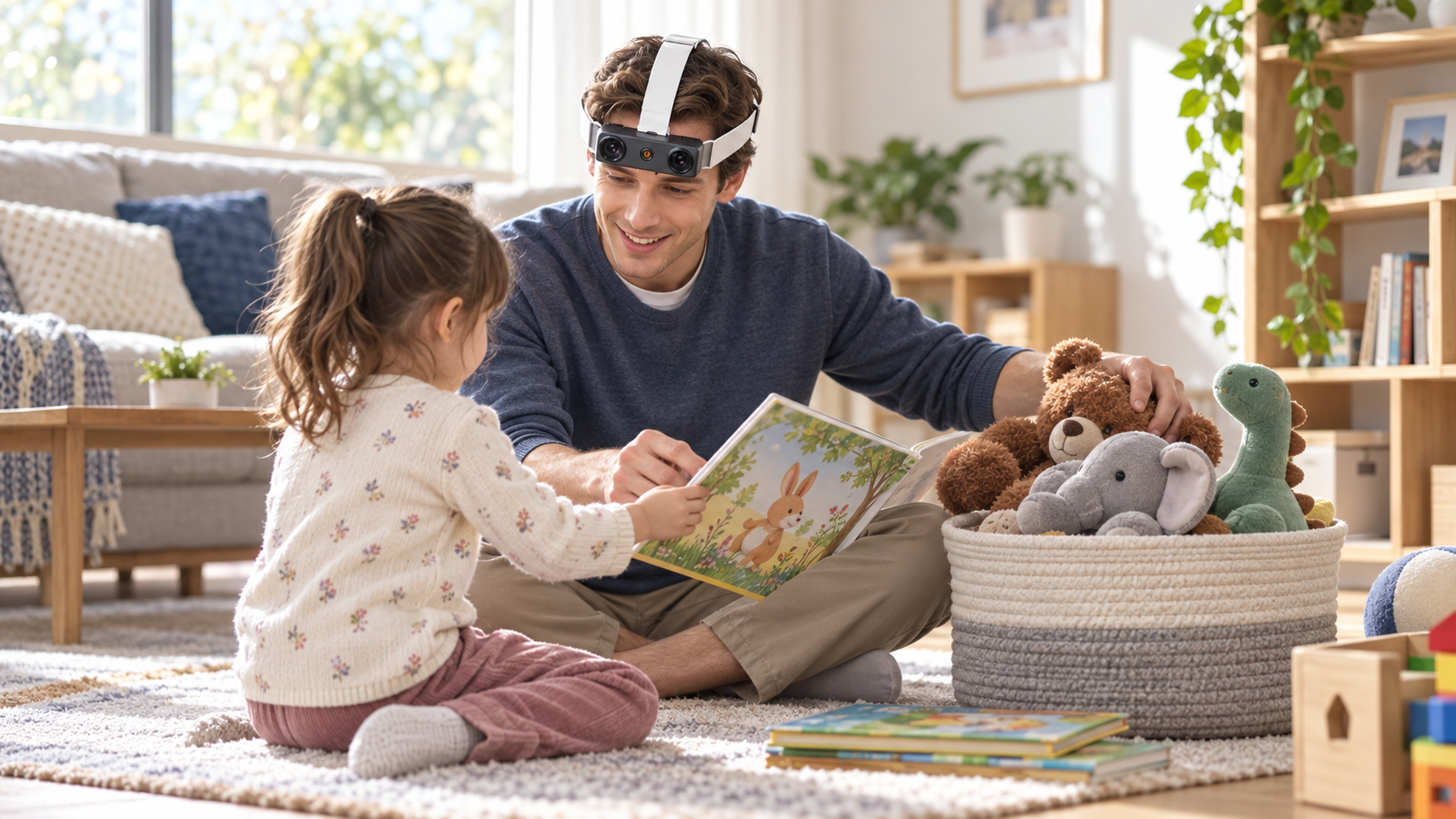
A caregiver offers two books, waits for a choice, moves a cushion, and helps return toys to a basket. The activity is ordinary, yet its meaning depends on order, shared objects, pauses, and the adult's response. A short first-person recording can preserve this context for an approved caregiving study or reflective discussion.
The BabyView Project studies children's everyday experience through child-perspective video and also releases motion data and annotations. Its official dataset page describes family consent and controlled researcher access. Those design choices show why both context and governance matter. This article proposes a different viewpoint: an adult caregiver wears EGO R9 during selected routines.
Start with familiar, low-risk activities such as sharing a picture book, selecting a coat, organizing large soft toys, or packing an empty outing bag with a familiar comfort item. Rehearse camera operation without the child first. Use short, agreed recording windows and let the interaction unfold at its normal pace. Preserve the beginning and ending of the routine so a reviewer can see which object was offered, what changed, and whether the adult responded or paused.
R9's forehead-mounted form leaves the adult's hands free for the activity. The adjustable camera angle and 120-degree wide-angle lens can help include both hands, the shared object, and nearby context when an adult sits on the floor or at a low table. Check framing in each actual position before recording with a child. The view should support the study without encouraging the adult to stare at equipment or miss what is happening outside the frame.
The standard imaging specification is 1080P global shutter at 30 FPS. Global shutter helps avoid rolling-shutter skew when the adult turns from a basket to a book or moves an object across the scene. Test a normal-speed page turn, an object handoff, and a seated-to-standing transition using an adult-only rehearsal. Review the footage under the household lighting that will actually be used.
R9 offers 60 FPS and 1920 by 1200 as optional configurations. Confirm these options and their compatibility with the supplier rather than assuming they operate together. Higher temporal sampling may help a study inspect brief hand movements. Choose the configuration after checking whether reviewers can distinguish the events of interest, and keep that configuration recorded in session metadata.
The 6-axis IMU samples above 200 Hz, while shared clock and global timestamp support connect adult head movement with the image sequence. This helps reviewers locate the moment a shared object leaves and returns to the 120-degree field of view. Check timestamp order, sensor continuity, axes, and the exported session format during the adult rehearsal.
A compact annotation plan might identify the routine, the shared object, the adult's observable action, the start and end of an exchange, and whether relevant evidence is visible. Compare notes from two reviewers before expanding the collection.
Microphone support can preserve agreed spoken context, such as an adult naming an object or offering a choice. If audio is unnecessary, leave it out of the protocol. When audio is approved, test speech audibility and household background noise without recording private conversations. Transcription and speaker labeling remain separate processing steps, and children's speech may be misrecognized.
R9 records H.265 video in MP4 and supports T-Flash storage and a Type-C interface. Test the selected card, file-copy procedure, decoder, and annotation software using non-sensitive rehearsal footage. Check the first and last files, verify copied-file checksums, and rehearse a controlled interruption before a real session. Keep only the recording copies required by the agreed retention plan.
The replaceable strap, adjustable angle, and external-battery support are practical features for adult users. The stated external-battery runtime is approximately five working hours. Evaluate fit, temperature, strap drift, cable routing, and recording duration in an adult-only test. Keep hardware and cables out of the child's reach. Stop recording whenever equipment distracts the adult, causes discomfort, or interferes with care.
For every agreed routine, store the R9 unit identifier, camera angle, video mode, intrinsics reference, IMU and timestamp checks, audio setting, recording window, task version, and file checksum in the session manifest. This keeps the family-care recordings consistent and traceable across short sessions.
A practical evaluation asks whether its wide-angle global-shutter video, shared timing, high-rate motion data, and optional audio preserve enough evidence for the chosen routine. Start with one familiar activity, confirm that recording is unobtrusive and reviewable, and expand only when the family's boundaries and the project's data-quality requirements are both met.