
Robot Learning / Human Demonstrations / ENIGMA-51 and HumanEgo research / Nov 2, 2026
First Person Video Data Collection: Robot Screws with R8
Use EGO R8 first person video data collection to record stereo and IMU data for robot screw assembly and human demonstration research.
How does R8 support first person video data collection for robot learning?
- Capture first-person stereo video of the screwdriver, screw and supporting hand using R8’s synchronized cameras.
- Keep six-axis head-unit IMU samples alongside unified camera timing references.
- Researchers label the hand roles and visible fastening phases.
- Retain the selected IMU rate and supplied calibration with each session.
First person video data collection with EGO R8 can document how a technician steadies a robot component, positions a screw and turns a screwdriver during assembly. The head-mounted R8 supplies synchronized stereo views of the work area, while its six-axis IMU and unified timestamps provide head-motion context. Researchers can organize the egocentric video and timing references as human demonstration data for robot learning.
Research basis for first-person assembly recordings
ENIGMA-51 documents egocentric human interactions with tools, including screwdrivers, during an industrial-like repair procedure. HumanEgo (https://humanego-ai.github.io/) studies how researchers use human egocentric demonstrations for robot manipulation learning. These studies inform the proposed R8 robot-component workflow; the R8 characteristics come from its manufacturer's specification.
Plan a first-person robot screw assembly demonstration
Place a robot forearm component and a loose screw on the workbench. In each demonstration, the wearer steadies the component with one hand and uses the other to position and turn a screwdriver on the screw. Capture the approach, tool contact, turning motion and completed fastening as one continuous sequence. A researcher can record the starting component orientation and repeat the task with a different starting position.
Capture screwdriver contact in synchronized stereo
Arrange the component so the screwdriver tip, screw head and supporting hand are visible in the wearer's working view. Review a short trial before the next take. R8's two global-shutter cameras share a common hardware trigger or shutter signal. Preserve both views for the same action interval so the team can examine the component, tool and contact stage in paired stereo observations.
Associate visual and inertial data with assembly phases
The R8 head unit lists six-axis IMU sampling at selectable 100, 200 or 500 Hz, with unified timestamps for camera frames and IMU samples. Retain the selected rate and timing references with each session. During review, researchers can locate head-motion samples for the interval in which the wearer shifts attention from the screw to the screwdriver tip; the fastening action is reviewed in the video.
Prepare action and object-state labels
For each human demonstration, researchers can identify the visible screw, component, screwdriver and hand roles, then mark tool engagement, turning and the finished state. These task-phase labels help a robotics team review the first-person video alongside a separately arranged robot trial, connecting the human approach, tool contact and turning to the corresponding robot action.
Review a corresponding robot task
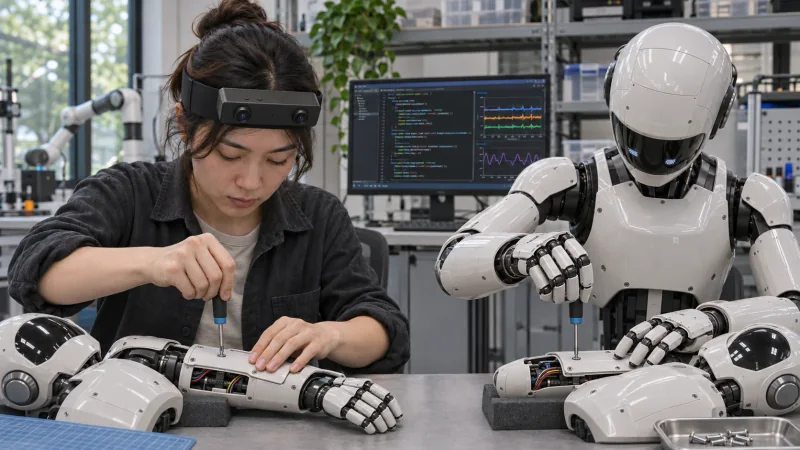
A robotics team can arrange a corresponding fastening task on a separate robot component and inspect the robot's execution alongside the human demonstration. The accompanying concept illustration presents a human working on a robot arm and another robot performing a corresponding screwdriver action, while a laboratory monitor displays example code and data for review. These activities represent a researcher-arranged workflow.
Preserve the collection context
For capture integration, R8 uses USB 2.0 and its specification lists SDK/API provision. Retain the supplied per-unit camera calibration, including intrinsics, distortion coefficients and stereo extrinsics where applicable, with the recorded views, timing references and researcher-created annotations. This keeps each screw-installation example associated with its collection context.