
Robot Learning Applications / EGO R9 Field Notes / Aug 13, 2026
From Kitchens to Care: Building Multi-Domain Robot Skills with First-Person Data
A practical look at how consistent first-person R9 capture can turn cooking, household care, craft, and training workflows into structured learning material for robots.
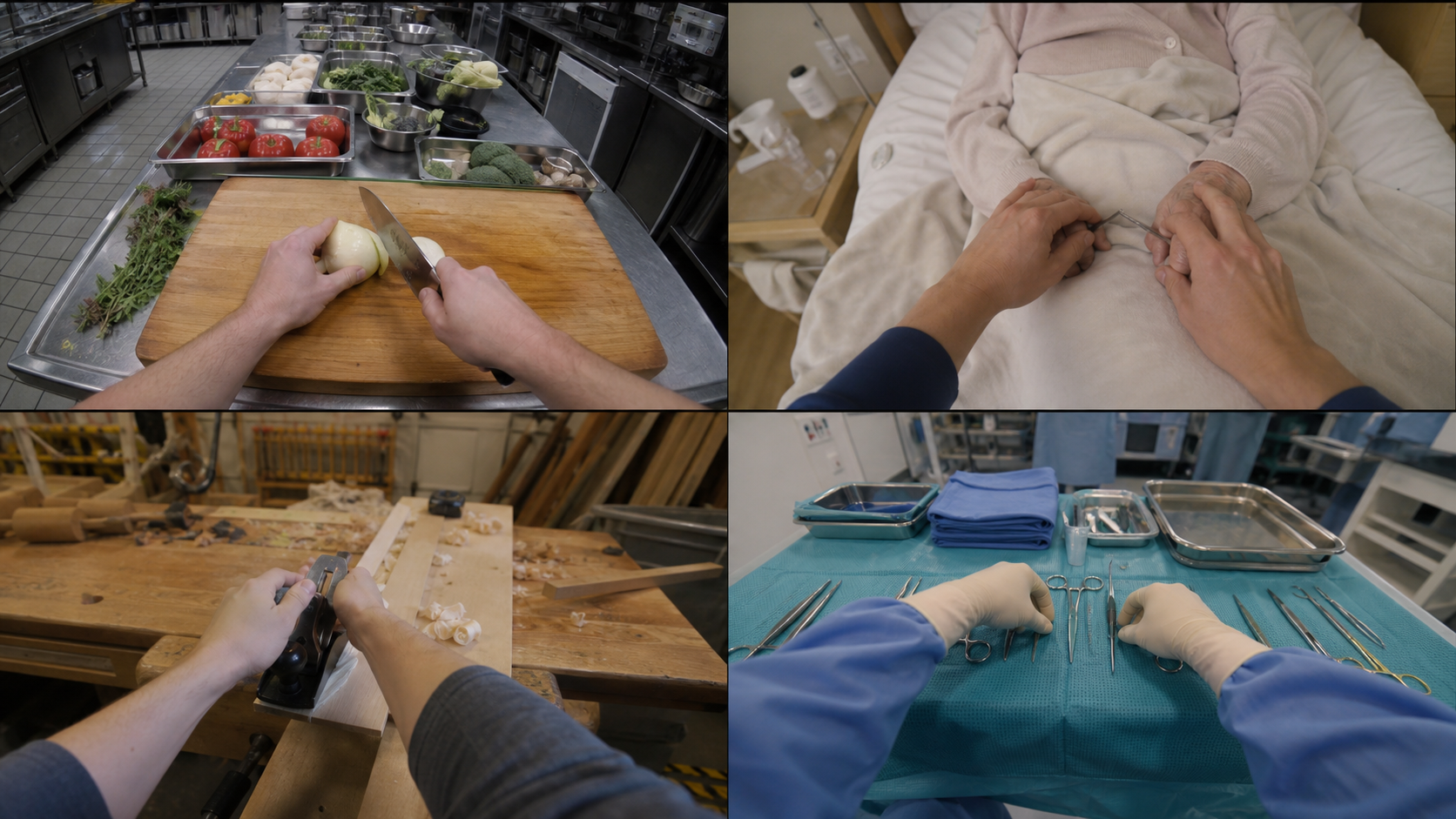
A robot that performs well in one carefully arranged lab may still struggle when the lighting changes, an object moves, or a person completes the same task in a different order. General-purpose embodied intelligence depends on diverse demonstrations that expose models to real environments, real tools, and the natural variation of human work.
Ego-centric recording is well suited to this challenge because the camera travels with the demonstrator. The resulting data follows attention and action through a complete task instead of observing from a fixed corner. When the same capture principles are applied across domains, teams can build datasets that share a common first-person visual language while retaining the special demands of each profession.
In a kitchen, useful demonstrations extend far beyond chopping. They include organizing ingredients, choosing a utensil, stabilizing food, controlling speed, moving between heat and preparation zones, checking doneness, cleaning the workspace, and plating. A head-mounted EGO R9 can keep both hands and the surrounding counter in view while the cook works naturally, creating evidence for dexterity, sequencing, and state-change understanding.
Household tasks add another kind of variation. Cleaning a surface, loading a dishwasher, folding fabric, or navigating around furniture requires repeated perception and adjustment. Rather than collecting only an ideal performance, a well-designed program can include different object shapes, room layouts, lighting conditions, and safe recovery from ordinary interruptions.
Care work demands a more human standard. Assistance for older adults should be recorded only with informed consent, clear privacy boundaries, and protocols designed by qualified care professionals. The useful lessons are gentle approach, communication, pacing, stability, and respect for personal space.
Skilled trades such as woodworking and electrical work reveal how experts coordinate gaze, hands, tools, and material feedback. Capturing measurements, tool approach, inspection, and correction from the wearer's viewpoint can support procedural understanding. The R9's global-shutter video and wide field of view are particularly relevant when hands and tools move quickly through a close workspace.
Care-training simulations combine object handling, communication, pacing, and changes of attention. EGO R9's hands-free 120-degree view can preserve the supply area, both hands, and the nearby interaction context, while global-shutter video and the high-rate IMU record movement through each planned stage.
Across all of these domains, consistency makes the data reusable. Teams should define task boundaries, timestamp events, record environment metadata, review hand visibility, document sensor configuration, and establish acceptance criteria before scaling. The EGO R9 supports that repeatable collection layer with hands-free first-person video, synchronized inertial measurements, and shared timing features.
Millions of varied demonstrations can help future models learn skills that transfer between environments, refine delicate motor behavior, and recognize human safety norms. It is a data-design problem, and every carefully captured first-person workflow can become one more lesson in how to interact with our world.