
Mining & Geological Operations / Original EGO R9 field guide informed by Boiger and colleagues' drill-core imaging research / Sep 14, 2026
From Core Tray to Inspection Route: Gold-Mining Workflows with EGO R9
Gold-exploration work links core trays, inspection routes, and expert observations. This R9 field guide uses hands-free global-shutter video, high-rate IMU data, and shared timing to document repeatable surface geological workflows.
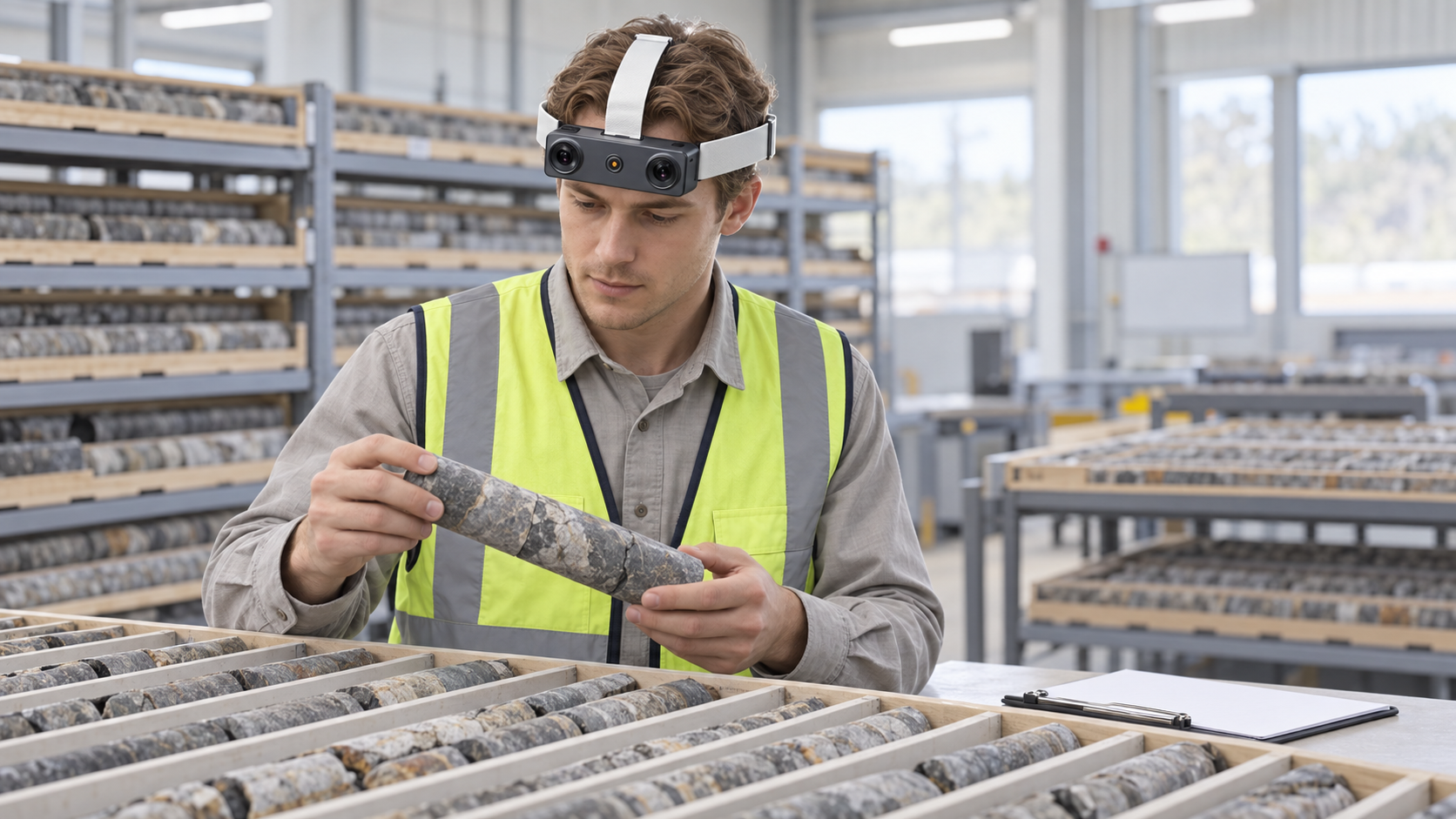
A geologist lifts a drill-core segment, rotates it under the light, returns it to the correct tray, and records an observation before moving to the next interval. Each action is simple, but together they preserve the relationship between material, position, viewpoint, and expert reasoning. In a gold-exploration programme, EGO R9 can provide a first-person record of an approved core-handling or inspection workflow while leaving both hands available for the task.
Boiger and colleagues' 2024 drill-core imaging research shows the value of consistent imagery and trustworthy labels in geological datasets. This R9 workflow applies that capture discipline to observable core handling, tray context, sample rotation, and spoken task markers in a surface logging facility.
Start above ground in a dry, controlled core-logging facility. Select a short, non-destructive exercise: verify a tray identifier through the site's normal system, inspect several permitted core intervals, rotate one segment using the approved handling procedure, return it to its original position, and record a spoken or written observation. Use training or cleared material for the first trial. The mine's geological procedures determine the work; the R9 plan determines whether the visible sequence can later be reviewed.
R9's forehead-mounted design keeps the geologist's hands free. Its adjustable camera angle and 120-degree wide-angle lens can include the core segment, neighboring tray compartments, and part of the logging bench in one view. Set the angle at the actual standing or seated position and check both the near tray and the handoff to a sample stand. A wide field of view preserves context.
The confirmed standard imaging mode is 1080P global shutter at 30 FPS. Global shutter helps avoid rolling-shutter skew when the wearer turns between trays or rotates a core segment. Test normal handling speed under the facility's real lights, then inspect still frames for core boundaries, fracture patterns, tray position, and exposure consistency.
Optional 60 FPS can provide more temporal samples during a quick rotation, while 1920 by 1200 is a separate optional resolution to confirm with the supplier. Record the delivered configuration for every pilot and compare available modes against the smallest visible feature required by the core-handling review.
R9's 6-axis IMU samples above 200 Hz. Shared clock and global timestamp support provide a basis for relating head turns and pauses to the image sequence. This may help analysts find stable viewing periods or explain why a tray briefly left the frame. Validate timestamp order, missing samples, units, axes, and measured image-to-IMU alignment on the delivered device. The IMU measures wearer motion.
Build a compact annotation record around observable events: tray entered, interval selected, sample lifted, surface rotated, feature indicated, sample returned, and observation completed. Link each event to the authorized sample identifier and mark image visibility, occlusion, frame interval, IMU interval, and global timestamp range.
For an approved route-inspection pilot, begin with a surface training area or non-hazardous simulated drift. Define start and end points, expected stops, lighting transitions, turns, and repeat visits. R9's wide-angle global-shutter video and high-rate motion record can help document what the wearer looked toward and how the route was traversed.
R9 records H.265 video in an MP4 container and supports T-Flash storage and a Type-C interface. Test the selected card, decoder, file-transfer procedure, microphone setting, and checksum verification using a complete surface-facility rehearsal. Connect the original file, operator code, approved area, camera mode, intrinsics reference, and sample or route identifier in the session record.
The replaceable strap and external-battery support suit adult evaluators working across several short sessions. The specification states approximately five working hours with an external battery. Measure endurance, device temperature, strap stability, camera-angle consistency, and cable clearance with the confirmed recording configuration.
A practical acceptance review asks whether a qualified geologist can follow the handling sequence, identify the relevant tray context, locate stable views, and distinguish visible evidence from missing evidence. Separately verify video continuity, IMU continuity, timestamp behavior, file integrity, and access controls. Used within approved boundaries, R9's value is a combined hands-free record of wide-angle global-shutter video, high-rate inertial data, and shared timing for training, process review, and future research datasets.