
Data Collection / TINTELE GLOBAL CO., LIMITED / Jul 27, 2026
High-Quality Egocentric Data Collection for AI and Robotics Training
High-quality first-person datasets depend on clear task design, visible hand-object interaction, stable timing, traceable metadata, and consistent review from pilot capture through delivery.
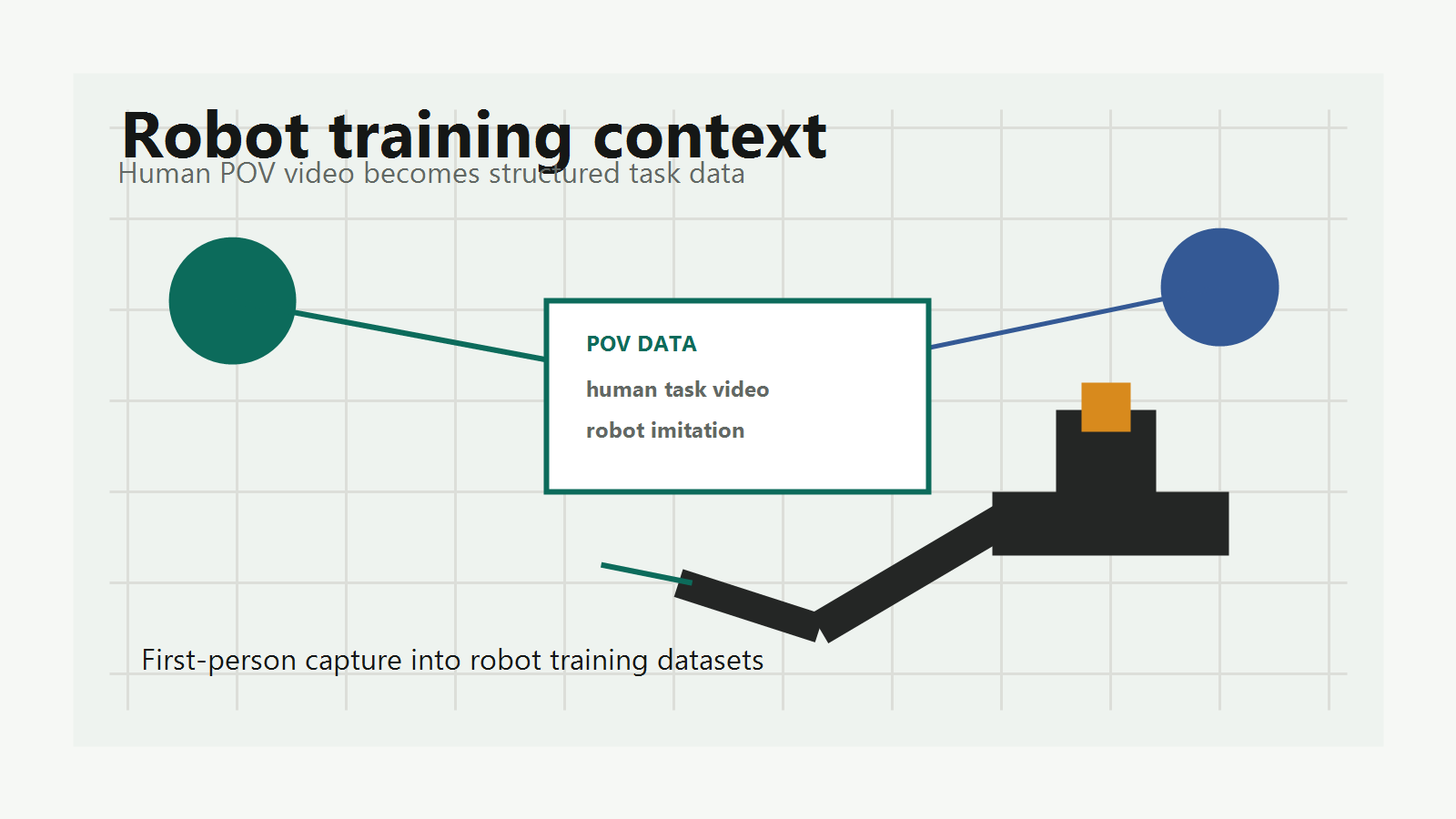
Egocentric data collection records activity from the participant's first-person viewpoint. When hands, tools, objects, and the active workspace remain visible together, the recording preserves action order and changes in object state.
A strong project begins with a narrow task definition. Each sequence should have an observable starting state, meaningful action stages, a completed state, and clear criteria for image and motion-data usability.
Capture design should match the application. Assembly work emphasizes fast hand motion and small parts; warehouse work adds walking and shelf transitions; household tasks add varied layouts, lighting, and object shapes. A representative pilot reveals the framing and continuity requirements for each environment.
Session metadata makes recordings traceable. Useful fields include device identifier, recording configuration, task version, participant code, location, start and end time, file list, checksums, and review status.
Quality review should inspect visible task stages, frame continuity, motion-data continuity where present, timestamp order, file integrity, and consistency across repeated sessions. Review examples should include ordinary corrections and changes of viewpoint as well as successful task completion.
Annotation design should follow observable evidence. Event boundaries, object identities, hand-object interactions, occlusion, task state, and reviewer confidence can be recorded separately so later teams can select the fields required by their model or benchmark.
A scalable collection program grows in measured stages: small pilot, revised protocol, multi-participant trial, site expansion, and production review. The same acceptance checklist and metadata contract should follow every stage.
TINTELE GLOBAL CO., LIMITED applies these principles to first-person data planning for embodied AI and robot-learning projects, connecting capture requirements with repeatable task protocols, review criteria, and delivery structure.