
Human Demonstrations / Dish Stacking / Original EGO R8 application guide; Ego4WAM robot-learning research / Oct 19, 2026
Human Demonstration Data for Robotics: Dish Stacking with R8
Use R8 stereo capture to record plate and bowl stacking as human demonstration data for robotics, with reviewed task phases for researcher-led robot learning.
How can R8 record dish-stacking demonstrations for robot learning?
- Capture plate and bowl placement from the demonstrator’s viewpoint with R8’s dual global-shutter stereo cameras.
- Retain the original left/right pairing and camera timestamps while researchers review rim contact, seating and hand release.
- Use the listed 115° horizontal and 80° vertical field of view to frame both hands and the receiving stack.
- Researchers associate the R8 human take with a robot trial using the same task definition and corresponding visible phases.
Explore EGO R8 specifications and manufacturer documentation
Human demonstration data for robotics can capture the small decisions that make a stack of dishes orderly: where to grip a rim, how to hold the next bowl above the stack and when to release it. EGO R8 records this work from the demonstrator's viewpoint using dual global-shutter stereo cameras. In the proposed collection here, the human stacks plates and bowls while researchers retain the paired observations and reviewed task phases for a robot-learning study. The human demonstration and the team's robot trial share a clearly defined stacking task.
Research context: aligned human and robot tasks
Sun and colleagues' Ego4WAM study examines how egocentric human data is used for robot learning and how human and robot task settings are aligned. Its real-robot examples include 'Stack Plates and Bowls.' The paper also describes collecting human demonstrations under corresponding task and environment conditions. These findings motivate a proposed R8 dish-stacking collection with a common object arrangement and task definition. The camera specifications below come from the R8 manufacturer document, while researchers design the demonstrations, prepare learning inputs and configure their robot experiments.
Define a complete dish-placement demonstration
Begin the R8 session with a set of plates, a set of bowls and identified receiving positions on a clear work surface. Describe the intended result in concrete terms: place each selected item onto its matching stack and withdraw both hands. During a bowl demonstration, let the participant lift the bowl at its sides, bring it above the receiving stack, lower it into place and release it. Keep the whole action, including any visible adjustment before release. Record the item order and the starting stack contents with the take.
Frame the bowl rims and receiving stack
For the dish-stacking bench, R8 provides a fixed-focus view spanning a listed 115° horizontally and 80° vertically. Check the two images with the demonstrator holding a bowl at the near and far edges of the intended placement area. Both rim contact points and the receiving stack should be visible as the bowl moves down. Inspect a completed placement as well: the final stack and departing hands provide evidence for the end of the demonstrated action. Keep that framing consistent when recording the plates.
Keep the two R8 camera views paired
R8's global-shutter sensors expose the pixels within each image together. The documented common hardware trigger or shutter signal pairs the left and right camera observations. Preserve those view identities when selecting frames of a bowl hovering over the stack, making contact and settling into position. The researcher can then retrieve both recorded views of a particular placement interval. In this workflow, stereo pairing belongs to the R8 human-capture record and remains attached to the original camera timing.
Label the visible placement phases
Mark the R8 demonstration by visible task phases, such as 'item lifted,' 'above the stack,' 'item seated' and 'hands withdrawn.' Reviewers assign the labels and their start and end times from the recorded footage, using the original camera timestamps as the reference. Keep the dish identifier with each interval so a later reach toward another bowl begins a distinct action. A short repositioning movement can remain inside the same placement episode when it concerns the same dish.
Relate the R8 demonstration to the robot trial
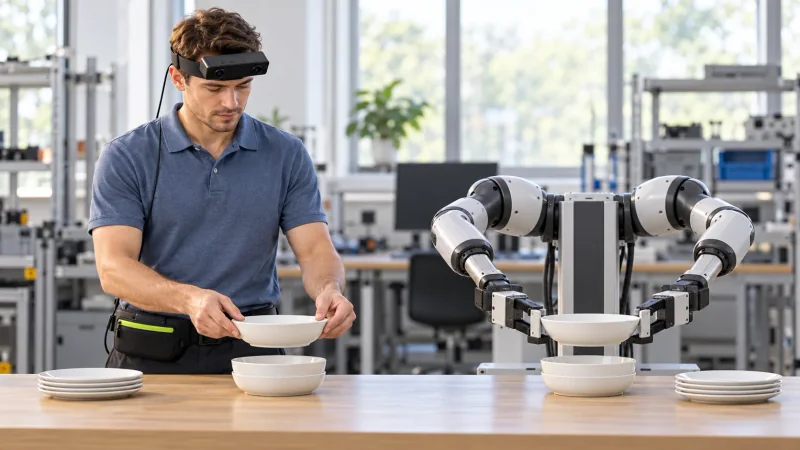
For the researcher-configured robot trial, use the same task description, dish order and receiving-stack arrangement as the selected R8 demonstration. Give the human take and robot take their own identifiers. During review, researchers can place excerpts side by side at a corresponding phase, such as both subjects holding the next bowl above their respective stacks. This makes the object arrangement and action stage explicit when inspecting the learned behavior. The accompanying concept illustration shows that correspondence through matching human and robot placement poses.
Retain head-motion data when configured
The wearer may look between the plate supply and the receiving stack during an R8 take. R8 lists a 6-axis IMU with selectable 100, 200 or 500 Hz sampling and unified timestamps for camera frames and inertial samples. When head-unit inertial recording is included in the session configuration, retain the chosen rate and samples alongside the dish-placement video. Researchers can return to the same time interval to review a viewpoint change and the hand action visible around it.
Prepare the R8 acquisition and learning records
R8's USB 2.0 connection and delivered SDK/API documentation provide the acquisition interface for the research team's recording setup. Organize each complete human take with its stereo view identities, original timestamps, actual capture settings and any configured IMU file. Keep the team's dish identifiers and phase labels as associated records. Researchers prepare the training representation, configure the robot policy and assess the subsequent robot trials, retaining the link from each selected human clip to its R8 source recording.
Start with one reviewed stacking episode
A focused human demonstration data for robotics pilot can therefore center on a reviewable stacking episode: the initial dishes, the complete human placement sequence and a researcher-prepared robot-trial reference for the same task. Check whether the human recording shows the rim contact, the receiving stack and the final release before extending the collection. Discuss the bench arrangement, stereo capture configuration, IMU option and required SDK/API deliverables with the EGO team when selecting R8 for the project.
Research reference and R8 specifications
Ego4WAM research — egocentric human data and dish-stacking tasks
Explore EGO R8 specifications and manufacturer documentation