
Human Demonstrations / Rope Manipulation / Original EGO R9 application guide; DexAgent egocentric robot-learning research / Oct 19, 2026
Human Demonstration Data for Robotics: Rope Knotting with R9
Capture human demonstration data for robotics with R9: first-person rope-knotting video at 1080P and 30 FPS, with timestamps for researcher-led review.
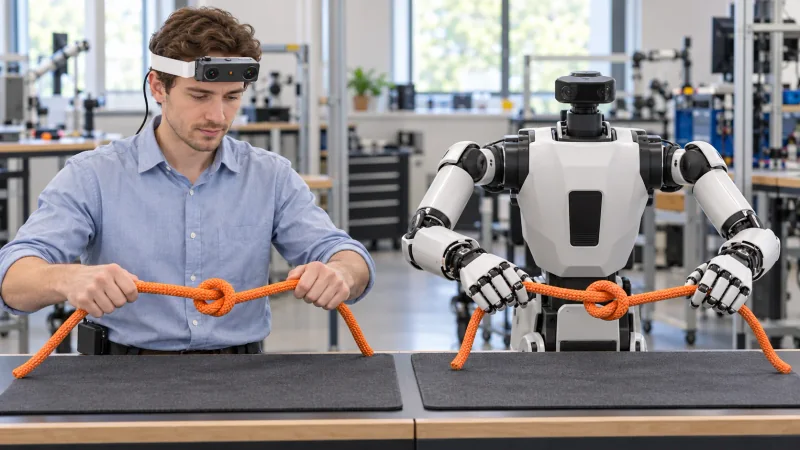
How can R9 record rope demonstrations for robot learning?
- Use R9’s standard 1080P global-shutter video at 30 FPS to record a complete rope-knotting action.
- Adjust the camera angle within the 120° wide-angle view to include both hands, the rope ends and the loop.
- Researchers label visible rope-state transitions against the R9 recording’s global timestamps.
- Organize human takes and researcher-configured robot trials by corresponding task phases, keeping their individual recording references.
Explore EGO R9 specifications and manufacturer documentation
Human demonstration data for robotics becomes more useful when a recording preserves how an object changes between the first grasp and the finished action. A loose rope is a clear example: the hands create a crossing, feed an end through a loop and draw the knot together. EGO R9 provides head-mounted, first-person video for a proposed rope-knotting collection, using its documented 1080P global-shutter recording at 30 FPS. Researchers can review the visible rope configuration and hand actions as inputs to their robot-learning study.
Research basis: egocentric demonstrations of rope manipulation
Wang and colleagues' DexAgent research includes rope knotting among its physical manipulation tasks. Its human demonstrations combine a complete egocentric recording with a written task prompt; its research software handles the subsequent simulation and robot-learning stages. This supplies a concrete motivation for an R9 collection centered on a complete rope interaction. The recording workflow below is an editorial proposal based on that task, with all R9 hardware information taken from the manufacturer specification.
Set the R9 view around the rope crossing
Prepare the R9 view around the whole working area, including both free rope ends and the space where the loop will form. The specified 120° wide-angle lens and adjustable camera angle are relevant here: set the angle while the wearer reaches naturally across the mat, then inspect a short recording. Check the view again with the hands close together at the crossing and farther apart during the final pull. Keep the rope distinguishable from the work surface throughout those movements.
Choose the documented R9 recording profile
Use R9's standard 1080P, 30 FPS profile and write that setting into the session notes. Its global shutter exposes the image pixels together within a frame, which is relevant as the rope end moves through the loop or the wearer turns toward a hand. Review the trial at the intended lighting and working distance, looking specifically for visible rope edges around the fingers. A usable take should preserve the action through the opening loop, the hand exchange and the final release.
Record the loop, threading action and final pull
Start each R9 recording with the rope resting in its documented initial arrangement and both hands visible. For the selected rope-knotting demonstration, capture the creation of the loop, the free end passing through it and the two hands drawing the rope ends apart. Continue until the wearer has put down the rope and withdrawn the hands. Keep any regrasping inside the take; its relationship to the changing loop is part of the observed demonstration. The collection team defines this particular knot and starting arrangement before the session.
Review rope-state changes with R9 timestamps
During review, use R9's global timestamps to locate the intervals where the rope changes configuration. The research team can label 'crossing formed,' 'end enters loop,' 'end emerges' and 'knot drawn together,' adding the acting hand and rope-end identity to each interval. Preserve the time reference when selecting excerpts from an original recording. When a finger covers the crossing, keep the frames before and after that moment with the same action interval so reviewers can inspect the visible sequence.
Connect human demonstrations to robot-trial review
To examine human-to-robot learning, the team can pair an R9 human take with a separately identified robot trial of the same defined rope task. Researchers organize the training procedure and configure the robot execution. During review, match visible phases such as the hands holding opposite ends of a loose knot before the outward pull. The illustration uses corresponding human and robot poses to communicate this learning objective. Each trial retains its own recording reference and timing, while the phase labels describe the task relationship.
Reset and identify repeated rope demonstrations
For repeated R9 demonstrations, reset the rope deliberately and record which end begins in each hand. Keep a take index for the initial loop arrangement, knot definition and any change in hand roles. Review the recording before accepting it into the collection: both rope ends, the crossing and the final knot should remain interpretable during their relevant phases. This produces a focused set of examples that researchers can organize by the observed rope state, including the moments where the hands exchange or reposition their grip.
Keep R9 recordings and review labels together
R9 supports T-Flash memory-card storage and H.265 video in an MP4 container. Retain those original MP4 recordings alongside the take index and timestamped review labels, using a consistent identifier for each demonstration. External-battery support lets the recording team prepare power for a sequence of repeated bench tasks. Play back a short take before the collection begins, then check that every selected excerpt points to its complete source file and the intended knotting attempt.
Plan a task-specific R9 collection
For a focused R9 pilot, define the rope task, the required view of the crossing and the review labels before recording. Human demonstration data for robotics then has a specific visual subject: the ordered changes from a loose rope to a formed knot. R9 supplies the first-person recording and documented file format; the research team supplies the annotations, learning experiments and robot-trial evaluation. Share this capture plan and the required standard recording profile with the EGO Camera team when discussing an R9 sample.
Research references and R9 specifications
DexAgent research — egocentric demonstrations and rope manipulation
Explore EGO R9 specifications and manufacturer documentation