
Livestock Farm Operations / Original EGO R9 field guide informed by the MmCows multimodal dairy-cattle research / Sep 14, 2026
Along the Feed Lane: Livestock Farm Workflows with EGO R9
Feed preparation, barn rounds, and equipment checks contain practical knowledge that is difficult to capture from a fixed camera. This R9 guide describes a worker-worn recording workflow for farm training and research, with realistic image, timing, and field-use checks.
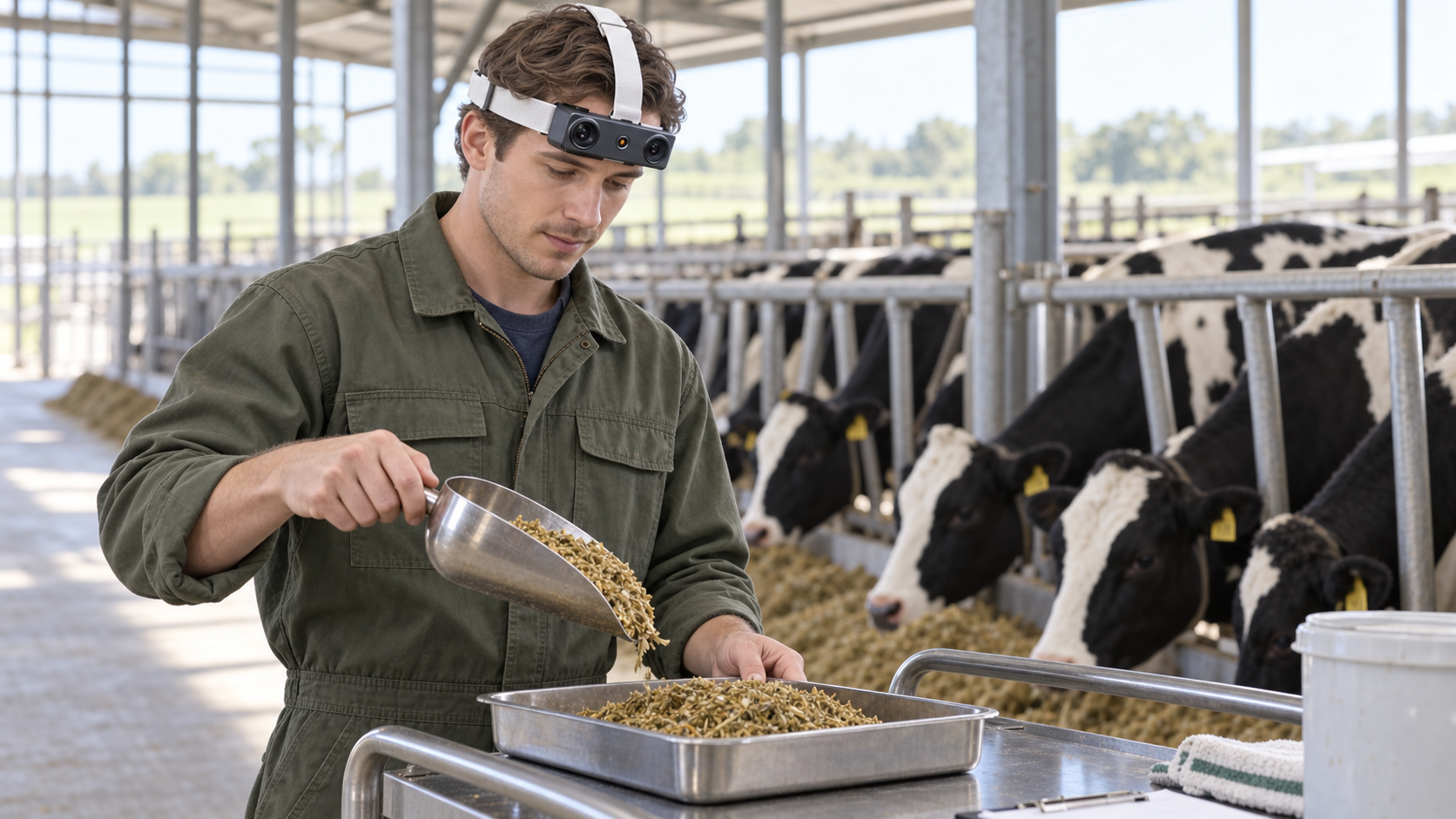
A livestock worker checks the feed preparation area, walks along a service aisle, pauses beside a water point, and returns to note an equipment issue. A fixed barn camera may show where the person went, while a first-person recording can show the item selected, the visible condition inspected, and the order of the work. EGO R9 offers a hands-free capture approach for documenting these small operational steps as training material or as evidence for a planned farm research project.
MmCows, presented at NeurIPS 2024 by Hien Vu and colleagues, combines dairy-cattle sensor measurements with several fixed camera views. Its official documentation makes timing, visual context, and individual records central to the dataset. That provides useful context for a farm capture plan, but the proposed R9 role is different: a worker wears the camera during selected rounds. Its recordings would be a separate source of operational context.
Use a dairy barn as the first example and agree a short route with the farm manager. Begin with feed-tool preparation, continue through a permitted service aisle, inspect the visible condition of a water point from its normal access position, and finish with an external check of unpowered equipment. Record the start and end of each task. The farm's established procedures define what the worker does; the recording plan defines which actions and conditions need to remain visible.
R9's adjustable camera angle and 120-degree wide-angle lens can bring the worker's hands, a scoop or container, and the nearby work area into the same view. Set the angle using a rehearsal at the preparation cart, then check it while standing in the aisle. A useful compromise retains both close task detail and enough context to identify the location. Avoid tilting the camera so far down that the recording loses the destination of a hand movement or the equipment being approached.
The standard specification is 1080P global-shutter video at 30 FPS. Global shutter is relevant when the worker turns from a cart toward a feed lane or moves a scoop through the image. It helps avoid rolling-shutter skew, while actual sharpness still depends on movement and light. Test the transition from daylight near an open barn side to the shaded interior, and inspect representative frames for hand detail, visible equipment features, and bright areas that have lost detail.
Optional 60 FPS can be evaluated for short handling actions, and 1920 by 1200 is an optional resolution to confirm separately with the supplier. Record the delivered mode rather than assuming every combination is available. Decide what must be recognizable before choosing a configuration: a large gate latch and a small printed batch code have different image requirements.
The 6-axis IMU above 200 Hz captures the wearer's acceleration and rotation. Together with shared clock and global timestamp support, it can help relate a head turn, walking interval, or pause to the video. Validate exported units, timestamp order, gaps, and measured alignment using a short dry-area rehearsal. These measurements describe the worker's motion.
If a project combines R9 recordings with existing farm logs or fixed cameras, create a documented alignment procedure. Record clock offsets and time zones, and use an agreed event visible in the relevant streams where practical. Keep original timestamps and a separate alignment record so analysts can distinguish a measured event from an estimated correspondence.
Build a small review vocabulary around the work: prepare tool, inspect location, handle container, check equipment exterior, record finding, and finish round. Attach a location code and time interval, then note whether the relevant evidence is clear, obscured, or outside the view. A reviewer may describe visible feed remaining in a lane without estimating intake from the image. Disease assessment, ration decisions, and treatment remain outside this capture guide.
Field suitability needs a practical check before a live pilot. Begin in a dry, controlled area, confirm environmental and cleaning limits with the supplier, and follow the farm's entry and equipment-handling rules. Check how the strap works with required workwear, secure the battery arrangement. Keep the device on the worker and use existing safe access routes.
R9's T-Flash storage, Type-C interface, and MP4/H.265 recording support a local collection and review workflow. Test a complete copy into the intended editing or annotation software and verify copied-file hashes. Use session names that distinguish farm, area, route, operator, and date without exposing unnecessary personal information. Microphone support may be useful for an agreed spoken observation, but fans and machinery can reduce intelligibility. Review sample audio before depending on verbal notes, and obtain permission from any recorded staff.
The specification lists external-battery support with approximately five working hours. Treat that as a planning reference and measure actual endurance with the chosen mode, card, and environmental conditions. For a pilot, start with short rounds and check remaining capacity, temperature, strap comfort, and camera-angle drift between them. Rehearse a controlled recording interruption with disposable footage, then verify file recovery. Longer battery availability is useful only when the files and task evidence remain complete enough to review.
Before expanding the programme, compare several repeated rounds and ask concrete questions: can a trainer follow the feed-preparation sequence, locate the equipment check, and see why the worker paused? Are video and IMU records continuous, and are uncertain observations marked? These are proposed acceptance checks rather than measured R9 farm results. With a confirmed field setup, R9's wide-angle global-shutter imaging, wearable form, high-rate IMU, and shared timing can make everyday farm work easier to document for training, process review, and future embodied-AI research.