
Field Hockey Skill Capture / Original EGO R9 guide; field-hockey decision-making research / Oct 8, 2026
Multi-View Sports Skill Capture for AI Coaching: Field Hockey with EGO R9
Plan field-hockey skill capture with EGO R9: 1080P global-shutter video, a 120° lens and timestamped 6-axis IMU data for coach-reviewed AI research.
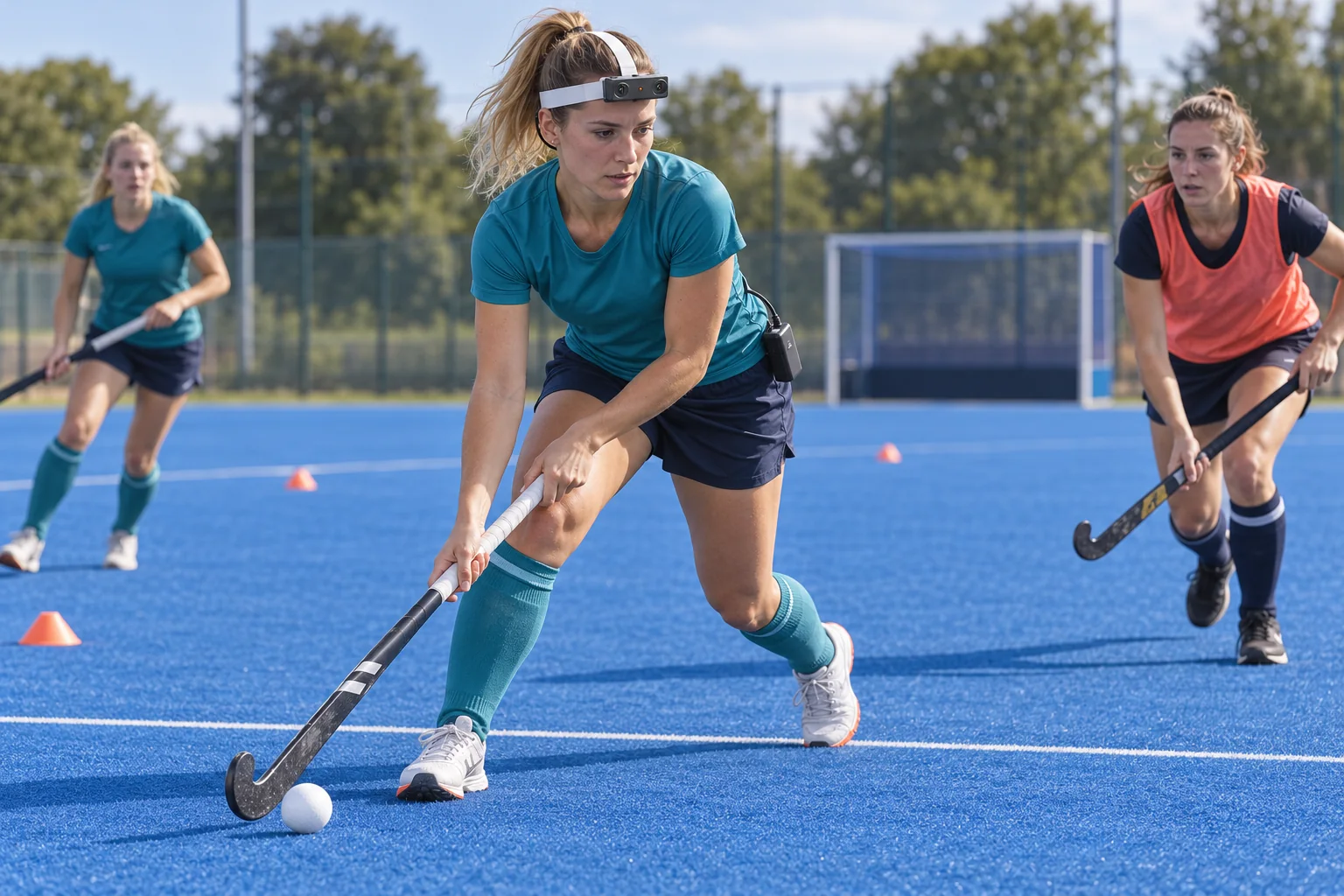
How can R9 support field-hockey data collection for AI coaching?
- Build a library of R9 first-person recordings from different player roles across repeated attacking drills.
- Frame play with the 120° lens and adjustable angle; record at 1080P and 30 fps, with 60 fps optional.
- Retain R9’s above-200 Hz 6-axis IMU samples and the recording’s shared-clock and timestamp information.
- Let coaches label visible actions and attacking choices, then prepare those examples for AI research.
EGO R9 records first-person video and inertial data that a coaching research team can organize around field-hockey attacking decisions. This proposed collection workflow builds a multi-view library by recording different player roles across repeated small-sided drills. R9 provides the footage and motion records; coaches identify the visible actions, add their assessments and prepare examples for AI coaching research. The central question is practical: what happened around the ball carrier as a passing or carrying opportunity developed?
Start with a defined attacking decision
A 2025 field-hockey study by Bente M. van Dijk and colleagues used three attackers, three defenders and a goalkeeper in coach-designed scenarios. Players faced choices between carrying into space and passing to a teammate as defensive positions changed. That drill structure provides the application basis for an R9 collection. Select a coaching question, such as when a supporting attacker becomes available, and record the starting roles and intended decision before the first repetition.
Build multiple player perspectives with R9
For the R9 pilot, record a block from the ball carrier’s forehead-mounted viewpoint, then record a supporting attacker during further repetitions of the same drill. Keep the role and repetition number attached to every file. The resulting multi-view library contains distinct player perspectives across those repetitions. A coach can select examples of the same attacking choice from each role and explain how the available passing space appears in the recorded view. Preserve each recording’s own time reference when organizing these examples.
Frame the stick, ball and developing play
R9 specifies a 120° wide-angle lens and an adjustable camera angle. Use a short field-hockey rehearsal to set the angle while the wearer adopts a low ball-control stance, advances and turns toward a teammate. Replay the saved footage and inspect the stick–ball interaction and the portion of the pitch ahead. Set the framing around the selected coaching question, then repeat the check when moving the R9 between ball-carrier and supporting-player roles.
Choose a documented video mode for action review
The R9 specification lists 1080P recording at 30 fps, with 60 fps as an optional configuration. It also specifies a global shutter, which captures each image with a common exposure interval across its pixels. For a drill containing a stick movement and a change of running direction, review sample frames at the selected setting before recording the full block. Record the actual frame rate with the clip so the coach’s event markers can be traced to the original R9 sequence.
Keep head-unit motion with the video record
R9 includes a 6-axis IMU sampled above 200 Hz, together with shared unified clock and global timestamp support. Retain the inertial samples and timing records associated with each R9 recording as the wearer changes direction during the attacking sequence. Researchers can select the motion interval corresponding to a coach-marked video segment for visual-inertial analysis. Keep the original timestamps with those extracts and record the R9 unit identifier alongside the player role and drill repetition.
Annotate the decision and the action separately
When reviewing an R9 clip, the coach can mark the visible sequence: control of the ball, development of a passing option, the selected pass or carry, and the following action. Add a short explanation tied to what is visible in that interval. For example, a note may describe a teammate moving into an available lane before the ball is released. Store the coach’s intended option, observed action and explanation as separate entries, each linked to the relevant R9 frames.
Prepare coach-reviewed examples for AI research
An AI coaching research collection can pair each selected R9 clip with a question and a coach-written answer about the attacking choice. Label the wearer’s role and the interval being assessed so researchers know which perspective supports the answer. Keep all clips from a drill repetition together when assigning training and evaluation material. The research team then develops and evaluates its chosen models using those annotated recordings, while coaches retain the original R9 footage for checking the evidence behind a response.
Organize the recordings between drill blocks
R9 documents MP4 files, H.265 video, T-Flash memory-card support, a Type-C USB port and external-battery support. Prepare the recording media and power arrangement before the session. Between blocks, replay a saved clip and check its frame rate, image framing and associated motion records. Organize the files by drill, repetition, player role and R9 unit, then attach the coach’s annotations to those identifiers. This keeps a short selected example connected to the complete source recording.
Plan an R9 field-hockey capture pilot
Begin with one attacking decision and a small set of repeated drills. Review the R9 angle, selected 1080P frame rate, timestamped motion records and saved files before expanding the collection across player roles. Share that capture plan with the EGO team when discussing R9 configuration. A carefully described pilot gives coaches and researchers a concrete set of first-person examples to annotate and use in their AI coaching work.
Research reference and R9 specifications
Field-hockey decision-making study — van Dijk and colleagues (2025)