
Field Testing & Robot Learning / Original EGO R9 field guide informed by Hampo Electronic / Aug 28, 2026
From Natural Demonstration to Acceptance Test: A Practical EGO R9 Capture Protocol
This field protocol connects natural hand-object demonstrations with R9 image, IMU, timestamp, storage, and recovery checks for repeatable embodied-AI data collection.
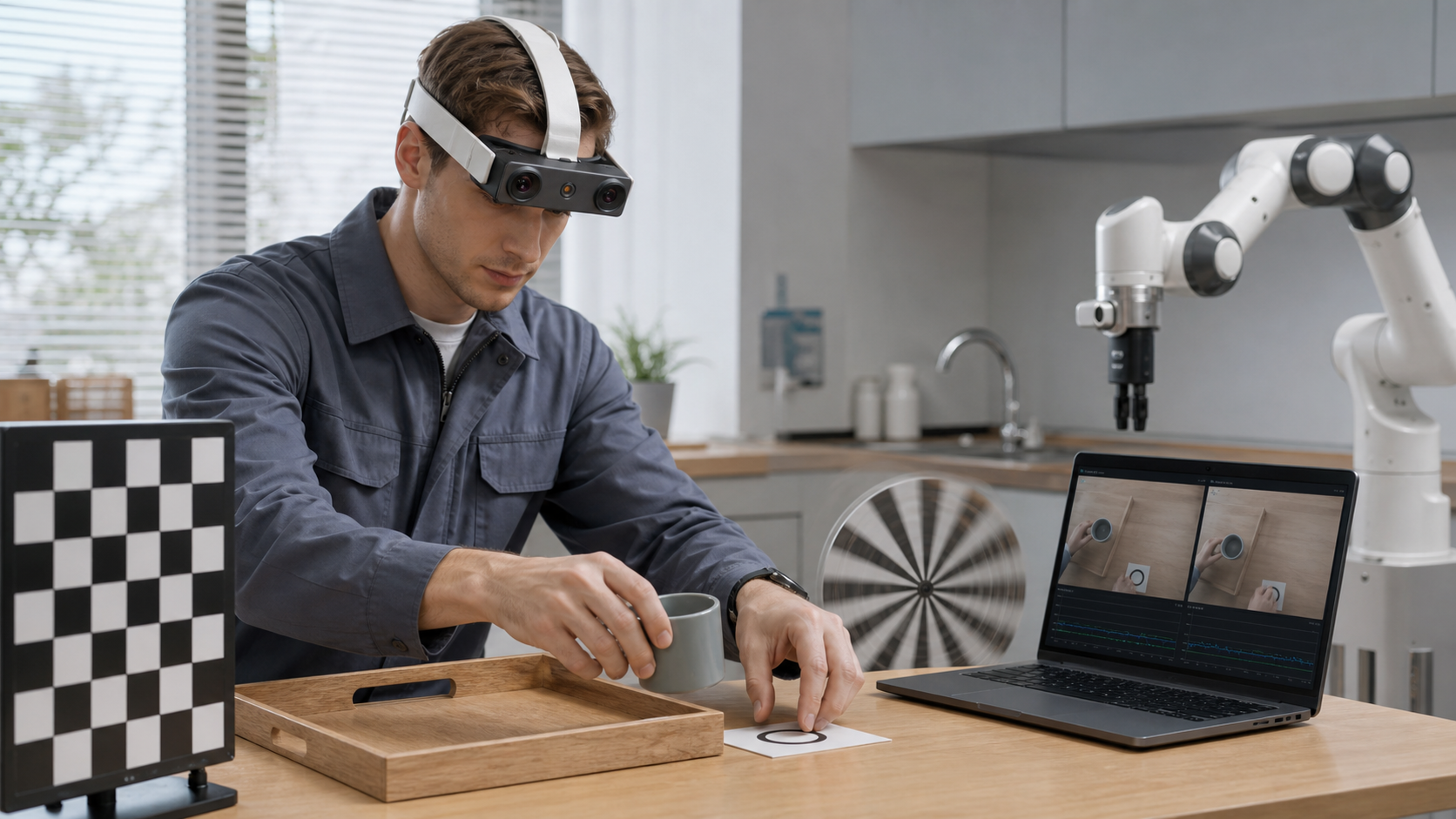
Head-mounted data collection is most useful when a participant can work naturally and the resulting record can pass a consistent engineering review. The strongest workflow treats viewpoint, motion, timing, configuration, and file handling as parts of one capture system.
EGO R9's confirmed configuration includes head-mounted 1080P global-shutter video, a 120-degree wide-angle view, 30 FPS standard recording, a 6-axis IMU above 200 Hz, a shared clock, and global timestamps. Optional 60 FPS and optional 1920 by 1200 configurations support project evaluation.
Begin with an ordinary task that contains clear state changes. A participant can select an object, move it to a marked target, open a container, sort several items, inspect the result, and return the workspace to its starting state. This exposes reaching, grasping, occlusion, quick head turns, two-handed interaction, and correction behavior.
R9's 120-degree view helps retain both hands, the active object, and nearby context as attention shifts. The adjustable camera angle supports consistent framing for a seated bench, standing assembly station, shelf route, or household task.
Test motion quality with a striped target, a moving straight edge, normal head turns, and brisk hand transfers. Global shutter helps preserve coherent contours during movement. Review representative frames for object boundaries, hand visibility, exposure, and task-state clarity.
Inspect the 6-axis IMU during stationary intervals, slow rotations, faster turns, a short walking loop, and a return to the starting pose. Record the selected test sequence and review sample cadence, axes, units, continuity, and its relationship to visible motion.
Shared clock support and global timestamps give the image and motion records one time basis. Verify timestamp order, recording identifiers, video frame sequence, and the position of a repeatable visible movement in the exported data.
Run a Type-C bench capture for setup review, then repeat the task using T-Flash storage and the selected external-battery arrangement. Check H.265 MP4 playback, storage margin, microphone capture when used, file naming, transfer, checksum integrity, and recovery with a disposable interrupted recording.
A pilot should include different participants, object sizes, workbench heights, lighting, task speeds, pauses, errors, and corrections while keeping task boundaries and review criteria consistent. This variation shows whether the selected R9 setup preserves useful evidence across realistic sessions.
The acceptance record should include the R9 unit identifier, camera mode, camera angle, intrinsics reference, IMU continuity result, timestamp result, storage result, battery arrangement, task version, and reviewer decision. These fields make each approved recording traceable.
The practical outcome is a repeatable two-part test: a natural first-person task followed by focused checks for image quality, IMU continuity, timing, and file handling. R9's global-shutter imaging, wide view, high-rate inertial sensing, and shared timing provide a strong foundation for scalable embodied-AI capture.