
Sparring Interaction Capture / BoxingVI: Action Intervals / Nov 20, 2026
Inside the Exchange: Recording a Sparring Round with R10
Plan 3D hand object interaction data collection with R10: record a sparring round in synchronized views and manually index glove contact, recovery and guard changes.
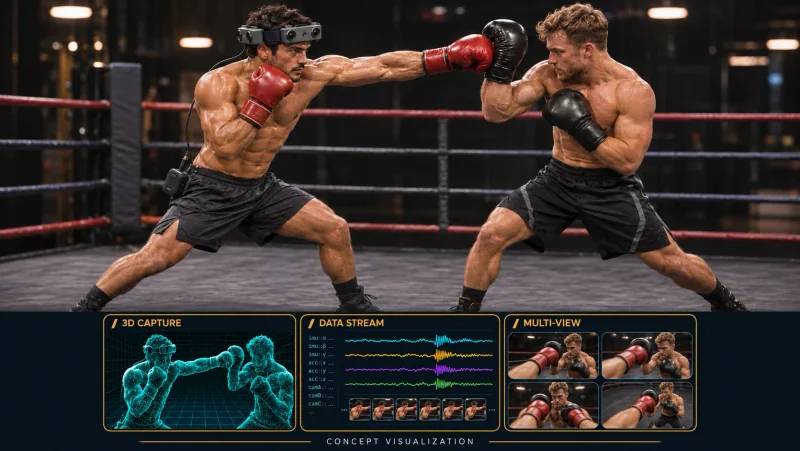
How can R10 record a complete sparring exchange for hand-object research?
- Retain the opening guard, glove approach and interaction, withdrawal, repositioning and round break in one continuous take.
- Use R10 camera synchronization with the documented 1600 × 1200 at 30 FPS imaging configuration.
- Have reviewers organise corresponding views, select recorded frame ranges and write glove-visibility and interaction labels.
Explore EGO R10 imaging, synchronization and IMU specifications
For 3D hand object interaction data collection in a sparring ring, EGO R10 provides synchronized head-mounted camera views of the fighter's gloves and the opponent's guard. This recording plan follows an elite athlete through one complete training round: opening stance, successive exchanges, recovery steps and the break. The gloves are the visible interaction objects. Researchers organise the captured views and add their own event labels for the intended hand-object study.
Use action intervals as the review unit
Kumar and colleagues' BoxingVI paper describes manually marking the beginning and end of punching sequences in video. That temporal approach informs the review plan here: retain the preparation and recovery around an exchange, then let a reviewer mark the relevant recorded frames. The R10 session described below is an original collection workflow built around the product's documented imaging and synchronization features.
Fit R10 and check the opposing guard
Fit the R10 multi-camera headband before the planned take. With both fighters facing one another, inspect the available views while the wearer raises both gloves, turns toward the opponent and changes stance. Include the opponent's gloves and the space between the athletes in the framing check. Record the camera identifiers and the arrangement used for this round so the same viewpoints remain recognisable during review.
Prepare the capture connection and settings
Prepare the USB 2.0 capture connection and the documented DC 5 V external power arrangement. Route the connection with the wearer's capture setup and inspect a short movement rehearsal. Select the listed 1600 by 1200 imaging configuration at 30 frames per second, then confirm that every intended camera stream is being received before starting the full take. Save the configuration with the round identifier.
Begin with the opening guard
Begin acquisition while the athlete holds the opening guard. Keep the lead glove, rear glove and opponent's raised hands in the initial sequence. Continue as the athletes close distance and the wearer begins the first exchange. This opening gives the reviewer a visible reference for the glove identities and the starting arrangement before the hands cross, separate or disappear behind a guard.
Follow the first glove exchange
During the first attacking movement, retain the glove leaving guard, approaching the opponent and meeting the opposing glove or passing into the defended space. Continue through withdrawal and the return toward the wearer's face. Keep the opponent's blocking movement in the same interval. The review unit is the exchange with its surrounding motion, rather than a single selected contact image.
Keep corresponding camera views together
R10 synchronizes its cameras to a common hardware trigger or shutter signal. Keep the corresponding view sequences together when the wearer rotates or the athletes move across the ring. For a selected exchange, inspect the available synchronized views at the same stage of the action. A glove hidden by the opponent in one image may be visible in another; the reviewer records what each view actually shows.
Retain recovery and the next exchange
Continue recording through combinations, defensive responses and changes of distance. Preserve the short pauses when the fighter restores guard, adjusts position and begins another exchange. Use the recorded 30 FPS sequence as the frame reference when selecting these intervals. Keep the approach, interaction and recovery frames in order so the next exchange can be understood within the ongoing round.
Save the selected IMU configuration
When the selected R10 configuration includes the documented six-axis IMU arrangement, note whether head or wrist units are present and save the chosen 100, 200 or 500 Hz sampling setting. Keep the available inertial recordings with the same session notes as the camera files. During review, distinguish movement of each fitted unit from the glove events described by the human annotator.
Keep the round break and original files
At the break, retain the athlete lowering their gloves and moving out of the exchange before acquisition ends. Check the beginning and ending portions of every saved view, then inspect several intervals from the middle of the round. Preserve the original camera files and keep any review clips in a separate folder under the same round identifier. The retained session includes both active exchanges and their transitions.
Create an index through human review
Build an interaction index after recording. For each chosen interval, a reviewer writes the round identifier, camera identifiers, first and last recorded frames, glove identities and a short description such as approach, visible glove contact, separation or guard reset. Add view-specific visibility notes when hands overlap. This human-prepared index connects the observed glove interactions to the synchronized recordings used in the research team's later 3D workflow.
How does R10 support 3D hand object interaction data collection?
How does R10 support 3D hand object interaction data collection in this scene? Its multi-camera recordings and common hardware synchronization provide corresponding observations of the gloved exchange. The specification also lists dual-camera calibration and 3D reconstruction functions. Keep the recorded views and collection settings available to the research team as it prepares the geometry and annotations for its chosen study.
Which parts of the round should stay in the recording?
Which parts of the round should remain in the recording? Keep the opening guard, approach to each exchange, the interacting gloves, withdrawal, repositioning and the round break. A reviewer selects meaningful intervals from that continuous context, preserving the hand changes that connect one exchange to the next.
How should glove visibility be reviewed?
How should glove visibility be reviewed? Use the camera identifiers to examine the same selected interval across the synchronized views. Mark which glove and opposing guard are visible in each view, then retain those observations beside the selected frame range. The annotations describe the recorded evidence and form part of the research team's dataset preparation.
Technical reference and R10 specifications
Kumar et al.: BoxingVI video action segmentation and labeling
Explore EGO R10 imaging, synchronization and IMU specifications