
Mixology Workflow Capture / Knab et al.: BARISTA egocentric annotation research / Nov 25, 2026
From Jigger to Garnish: Recording Cocktail Work with R9
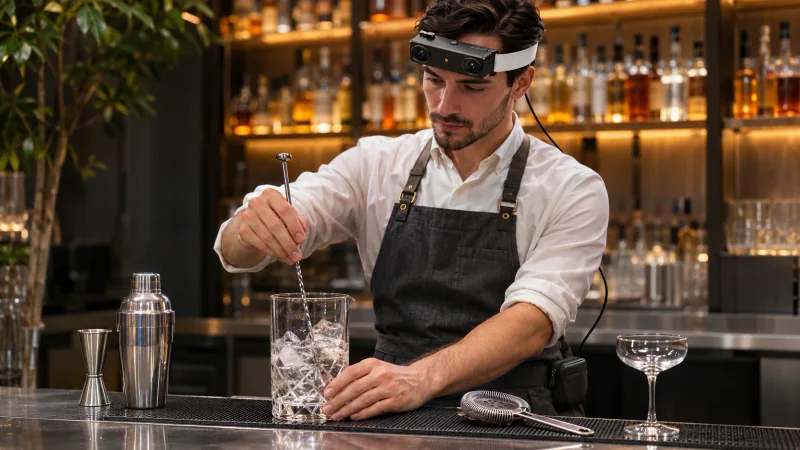
Plan 3D hand object interaction data collection with R9: record cocktail measuring, shaking, stirring and straining with first-person video and IMU timing.
How can R9 record cocktail work for hand-object interaction research?
- Record measured transfers, two-handed shaking, spoon stirring, straining and garnish placement through complete drink takes.
- Set the R9 working view with its adjustable angle and 120-degree lens; retain 1080P, 30 FPS global-shutter video.
- Keep the six-axis IMU record above 200 Hz with the shared clock and global timestamps for head-mounted motion context.
- Researchers label drink IDs, tool identities, hand contacts and intervals against the original recordings.
Planning 3D hand object interaction data collection at a cocktail bar begins with a clear record of the hands, the utensils they hold and the order in which those utensils change. In this proposed EGO R9 recording session, a bartender wears the camera through measuring, shaking, stirring, straining and garnishing. R9 provides first-person global-shutter video with a head-mounted inertial record; researchers organise the visible contacts and timing as inputs to their own interaction study.
Give each utensil a consistent identity
Knab and colleagues' BARISTA research links persistent object identities with hand-object relations, fine-grained activities and larger process steps in egocentric recordings. Use that organisational idea for the bar: distinguish the jigger being filled from the same jigger being emptied, and a shaker held for mixing from a shaker tilted for straining. The labels and object identities in this recording plan are prepared by the reviewer.
Plan shaken, stirred and built drink takes
Plan three drink takes around the International Bartenders Association's documented methods. Alexander supplies a shaken sequence, Boulevardier a stirred sequence, and Americano a drink assembled in its serving glass. Write the selected recipe name beside each take identifier. Arrange the bottle positions, jigger, shaker, mixing glass, spoon and serving glass before putting on R9 so the reviewer can follow how each utensil enters the bartender's hands.
Set the R9 view over the bar mat
Fit the R9 head strap and use its adjustable camera angle to establish the bartender's view of the work mat. Rehearse reaching for a bottle, holding the jigger near the shaker and stirring inside the mixing glass. R9's documented 120-degree lens provides the working view; check the saved rehearsal for the actual visibility of both hands, vessel rims and the space where a measured ingredient is transferred.
Record the measuring and transfer sequence
Prepare the documented 1080P, 30 FPS recording configuration and save the R9 device and take identifiers with the session notes. Start before the first bottle is picked up. Retain one hand raising the bottle while the other presents the jigger, followed by the bottle being tipped back upright. Continue as the jigger turns toward the chosen vessel and returns to the mat. These transitions distinguish measuring from transferring.
Follow shaker assembly and the two-handed hold
For the Alexander take, follow the bartender adding the selected ingredients and ice to the shaker, then joining its parts. Keep recording as the hands move from separate tools to a two-handed hold around the closed shaker. Include the shaking interval, the pause and the return to the work mat. The IBA method supplies the shake-and-strain sequence; the R9 recording plan preserves the visible grips surrounding each stage.
Retain the complete movement interval
R9's global shutter exposes the image together as the bartender moves the shaker or turns toward the bottle rail. In the saved take, review the fingers securing the vessel, the change of hand position and the moment the shaker settles on the mat. Preserve the lead-in and follow-through around that movement so a reviewer can mark a complete shake interval rather than an isolated pose.
Capture the change from shaker to serving glass
Continue through opening the shaker, positioning the strainer and tilting the vessel toward the chilled serving glass. Keep the hand securing the strainer and the hand controlling the vessel visible wherever the performed technique allows. Record the liquid transfer and the return to an upright vessel, then the tool being set down. Those events separate holding, pouring and release in the interaction index.
Record spoon work and the straining transition
For the Boulevardier take, retain ingredients entering the mixing glass and the move from the jigger to the bar spoon. Follow the spoon hand around the glass while the other hand supports the vessel, then record the transition to straining. R9 stays directed toward the working area throughout. Preserve the bartender's chosen stirring interval and the subsequent grip change as separate, connected portions of the take.
Follow a drink assembled in its serving glass
For the Americano take, keep the serving glass on the mat while the bartender adds the ingredients over ice, adds soda and stirs gently. Follow the spoon being lifted away and the orange slice and lemon zest being placed as garnish. Retain the completed glass being moved toward the service position. This take provides a distinct contact sequence in which the preparation vessel is also the glass presented for service.
Keep head-mounted motion with the timeline
R9 supplies timing information through a shared clock and global timestamps. Its six-axis IMU has a specified sampling rate greater than 200 Hz. Retain the supplied inertial and timing records when the bartender looks from the work mat toward the bottle rail or serving position. These samples describe movement of the head-mounted unit. The video supplies the visible hand-tool events that a reviewer associates with the same time intervals.
Prepare a human-reviewed interaction sheet
After recording, build a bar-specific interaction sheet using drink ID, start and end times, left-hand object, right-hand object and action. Useful entries include bottle-to-jigger transfer, jigger-to-vessel transfer, shaker closure, two-handed shaking, spoon stirring, strainer placement and garnish release. Keep each tool's identity consistent when it is set down and picked up again. Review the entries against the full R9 take, including the pauses between steps.
What can R9 contribute to 3D hand object interaction data collection?
What can R9 contribute to 3D hand object interaction data collection at a bar? It contributes first-person global-shutter video and a timed head-mounted inertial record. Researchers select the relevant hand, utensil and vessel intervals, then define the spatial analysis used in their project. The collection described here centres on the recorded observations, original timing and human-reviewed interaction sheet.
Which cocktail actions should remain in the recordings?
Which cocktail actions should remain in the recordings? Retain measuring, ingredient transfer, shaker assembly, two-handed shaking, stirring, straining, garnish placement and the return of tools to the mat. Keep the selected drink's performed order and the hand changes between utensils, allowing a reviewer to reconstruct the complete preparation sequence from the source take.
How should the different drinks be organised?
How should the different drinks be organised? Give each take its recipe name and identifier, preserve the R9 recording configuration and timing records, and attach reviewed intervals to that identifier. Keep the original take alongside the interaction sheet. This makes each label traceable to the bottle, utensil and glass visible during the bartender's demonstration.
Research, cocktail methods and R9 specifications
Knab et al.: BARISTA object identities, hand-object relations and procedural steps