
Tennis Point and Role Capture / Braicu et al.: Egocentric tennis dataset and annotation research / Nov 28, 2026
From Server to Returner: Tennis Doubles with R9
Use R9 as an egocentric camera for robot learning research: record tennis doubles service and return games with video, head IMU data and human point cards.
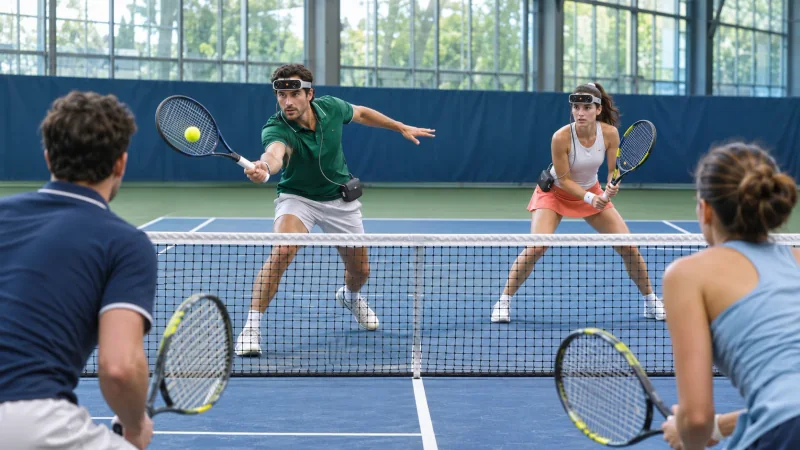
How can R9 capture the changing roles in tennis doubles?
- Follow one wearer across a service game and the opponents' next service game, indexed by game and point.
- Record in the documented 1080P30FPS global-shutter configuration, with adjustable framing and a 120-degree lens.
- Keep head-mounted six-axis IMU samples above 200 Hz with the video and R9 timing records.
- Prepare human-reviewed point cards connecting serve attempts, returns, volleys and partner coverage.
Explore EGO R9 first-person video, IMU and shared timing specifications
Use R9 as an egocentric camera for robot learning research to collect a tennis player's view of decisions that connect one shot to the next. This proposed indoor doubles session follows the same wearer through a service game and the opposing team's next service game. The resulting material combines R9 video and head-mounted inertial data with point cards prepared by researchers, preserving how a player moves from serving to returning and covering a partner.
Make each point a research record
The recording plan takes its research cue from Braicu and colleagues' egocentric tennis study. Their dataset preparation retains rally boundaries and racket-contact times as explicit annotations. Here, a point card connects the serve attempt, subsequent shots and the player's changing role. The cards are human-authored records for selecting and describing R9 clips within a robot-learning research project.
Assign roles before the first service game
Prepare one card for each point, with fields for game ID, point ID, wearer and starting role. Give every equipped player a separate R9 recording identifier. The United States Tennis Association describes the serving rotation across doubles games and the receiving positions retained during a set. Following two consecutive games therefore gives the primary wearer a serving block and a receiving block, with an identifiable change of role between them.
Choose the R9 recording configuration
Select R9's 1080P recording configuration at 30 FPS and enter it on the session sheet. Its global-shutter camera is relevant to the quick viewpoint changes between the receiver, the net player and a ball played wide. Make a short court-side recording first and inspect the saved pictures under the hall's lighting, including the moment the wearer turns back toward the net after completing a stroke.
Fit the view for both court roles
Use the adjustable camera angle to set the starting composition from the player's actual serve and return postures. With R9's 120-degree lens, inspect the net area, service box and nearby partner when they enter the view. Retain the chosen fitting for both games. If the fitting is changed, add that event to the session sheet so later clip selection retains the configuration that produced each view.
Keep serve attempts attached to their point
For the serving game, begin the point record while the wearer prepares the ball and racket behind the baseline. Record the preparation, toss, service motion and the next decision after landing. Where a second serve follows, associate both attempts with the same point card. This preserves a useful distinction between restarting the serve and continuing the exchange after a return has been played.
Follow the next shot after the serve
Follow the server's next action rather than finishing the clip at racket contact. A short return may invite an approach; another return may keep the wearer near the baseline. Keep the approach, changes of viewing direction and the next volley or groundstroke within that point's source material. The card records the visible sequence, including the partner's movement when it appears in the R9 view.
Separate the partner's plan from the movement
Before another point, retain any visible agreement between partners about court coverage. LTA coach Matt Smith explains how doubles partners coordinate positions and use signals to plan the serve and the net player's response. In this session, note a visible signal and then the actual movement separately. If the net player crosses to intercept, keep the wearer's response into the space the partner has left as part of the same point record.
Move into the receiving game
At the game boundary, create a new game ID while retaining the wearer's R9 identity. The opponents now serve. When it is the wearer's turn to receive, record the ready position, return preparation and follow-through before selecting a clip. On points received by the partner, identify the wearer as the returner's partner. This second game gives the collection several role contexts while keeping them attached to one player's recordings.
Review head motion within the point interval
R9's six-axis IMU samples above 200 Hz. Keep the head-mounted inertial stream with the video as the wearer checks the server, redirects toward a volley and turns to locate the partner. Shared-clock support and global timestamps provide the documented timing basis for reviewing R9's image and motion records. A reviewer selects a point interval and inspects that interval's frames and head-motion samples together.
Deliver point cards beside the original recordings
For the research handover, preserve each game's source recording and produce a separate point-card index. Enter the visible serve or return action, the partner's role, any coverage change and the selected clip boundaries. A second person reviews those entries against the source. Store the reviewed card beside its clip identifier, allowing a researcher to select examples by role and preceding play rather than by a short shot label alone.
Why record the same R9 wearer as both server and returner?
Why record the same R9 wearer as both server and returner? The two games show different preparations and responses from a consistent head-mounted recording position. Game and point identifiers keep service attempts, receiving duties and partner coverage distinct when the team prepares examples for further study.
What does an egocentric camera for robot learning contribute to this session?
What does an egocentric camera for robot learning contribute to this session? R9 supplies the first-person video, its head-mounted IMU stream and documented timing information. Researchers choose the tennis episodes, write the role descriptions and review the visible action intervals before organising clips for a learning project.
How should a volley be entered on the point card?
How should a volley be entered on the point card? Locate the visible racket action in the R9 recording, mark its interval and retain the return or preceding shot that led to it. Add the partner's visible position where relevant. The reviewed entry then describes the volley within that point's sequence.
Tennis research, doubles guidance and R9 specifications
Braicu et al. (2026): Egocentric tennis video and annotation methods
Explore EGO R9 first-person video, IMU and shared timing specifications