
Scalable Data Collection / Original EGO R9 analysis informed by FPV Labs and the Ego-OSCAR paper / Aug 24, 2026
Scaling First-Person Robot Training Data with EGO R9: Global-Shutter Video, 6-Axis IMU, and Shared Timing
Ego-OSCAR's 550-hour release highlights the operational discipline behind large egocentric datasets. EGO R9 supplies confirmed global-shutter video, high-rate inertial data, and shared timing for repeatable field collection.
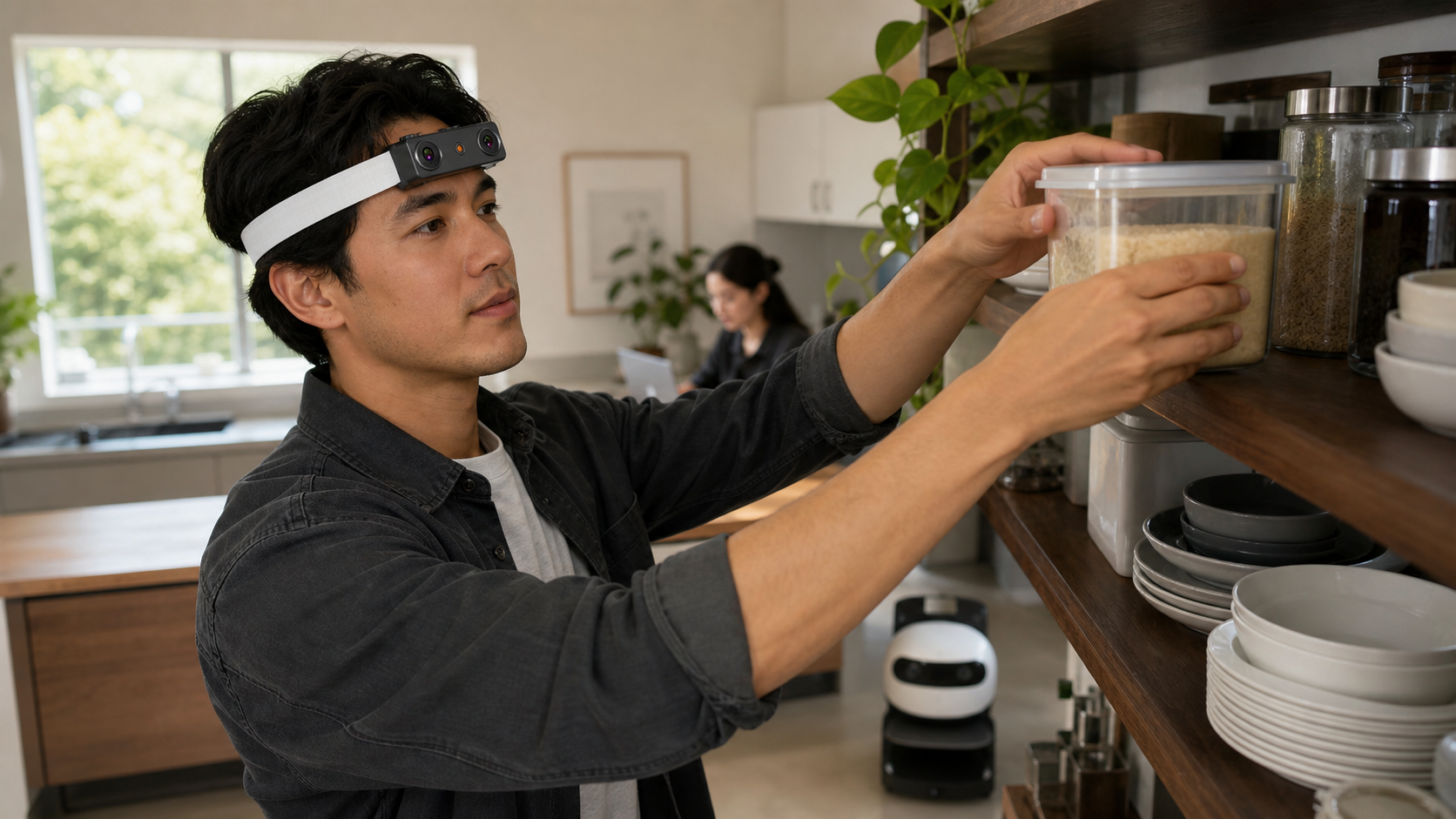
Large first-person data programs succeed when each session preserves a useful viewpoint, consistent timing, traceable configuration, task metadata, and reliable files. The open-source Ego-OSCAR project offers a useful case study in organizing hundreds of hours of egocentric collection.
FPV Labs reports roughly 550 hours of recording per camera across multiple operators and environments. The published release combines video, inertial measurements, calibration records, metadata, and annotations, demonstrating the importance of planning capture quality, field operation, and review as one scalable workflow.
EGO R9 provides a confirmed wearable foundation for that workflow: 1080P global-shutter video, a 120-degree wide-angle view, 30 FPS standard recording, a 6-axis IMU above 200 Hz, shared clock support, and global timestamps. Optional 60 FPS and optional 1920 by 1200 configurations are available for evaluation.
Human demonstrations contain fast head turns, reaches, grasps, and object transfers. Global shutter helps preserve frame geometry during motion, while the wide field of view retains both hands, the active object, and nearby context as the wearer changes attention.
R9's 6-axis IMU adds high-rate acceleration and rotation data between video frames. The shared clock and global timestamps give image and motion records a consistent time basis for locating approach, contact, transport, placement, and inspection events.
Camera-intrinsics support belongs in each session's provenance. Store the correct intrinsics file with the R9 unit identifier, firmware, selected video mode, camera angle, operator code, environment, task version, and original timestamps.
Operational checks protect usable data yield. At the beginning of each shift, verify recording state, T-Flash capacity, battery status, camera angle, strap position, timestamp continuity, and a short test clip. At transfer, confirm H.265 MP4 playback, file count, first and final frames, and copied-file checksums.
Ordinary environments provide valuable variation. R9's hands-free 120-degree view can record searching, reaching, grasping, placing, checking, and correcting across homes, workshops, laboratories, warehouses, and service areas while maintaining a consistent first-person perspective.
Start the scale-up with a measurable pilot. Choose representative tasks, define start and end states, verify hand visibility, inspect IMU continuity and timestamps, test file transfer, document camera intrinsics, and review the first recording hours against a consistent acceptance checklist.
Once those controls remain stable across participants and locations, EGO R9's global-shutter imaging, 6-axis IMU, shared timing, local storage, and wearable design can support a repeatable collection program that grows from a small pilot into a larger embodied-AI dataset.