
Sensor Synchronization / EGO R9 Engineering Notes / Aug 20, 2026
Shared Timing for Robot Manipulation Data Collection with EGO R9
EGO R9 combines 1080P global-shutter video, a 6-axis IMU above 200 Hz, a shared clock, and global timestamps to preserve the timing of first-person manipulation demonstrations.
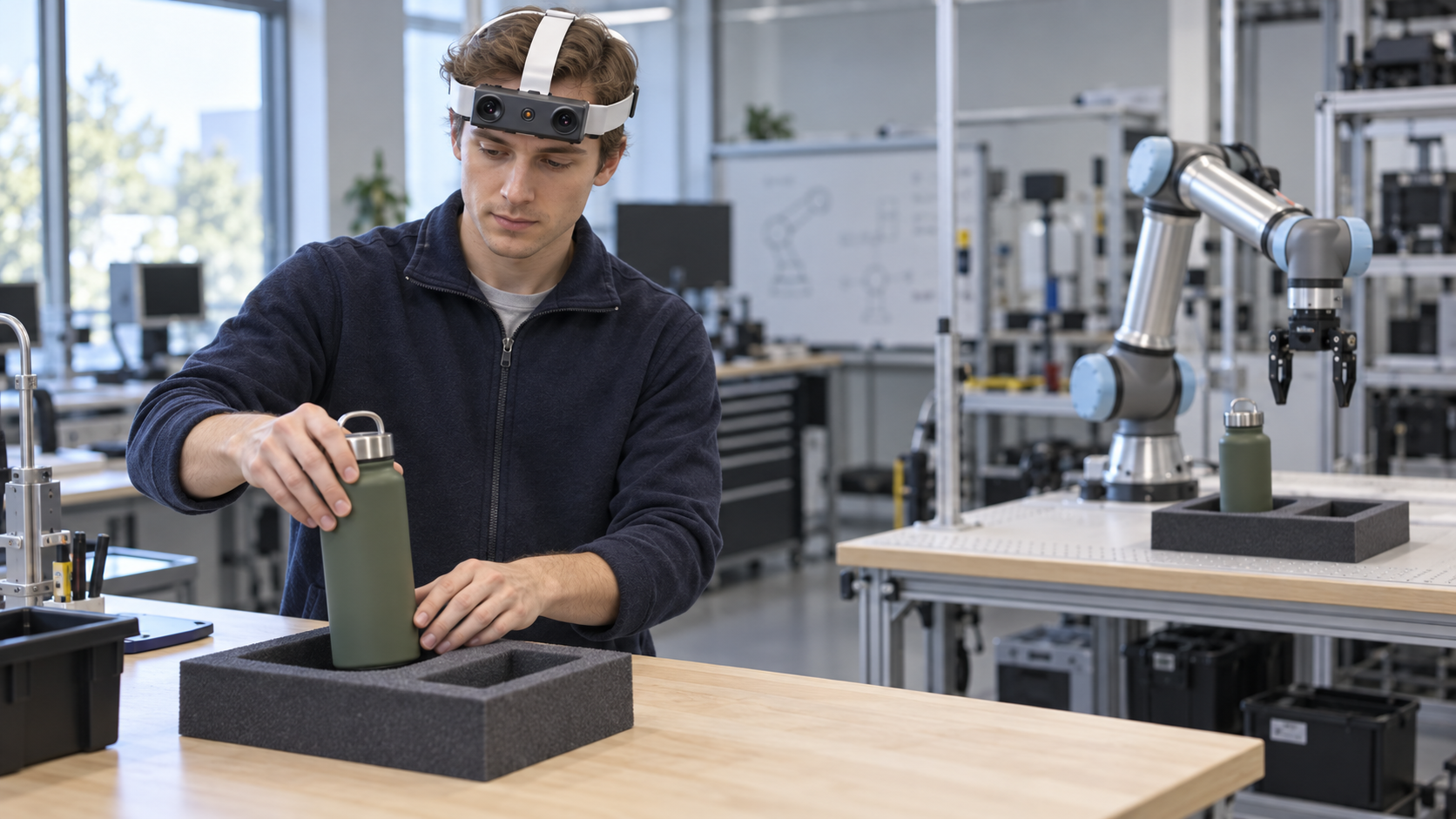
A manipulation demonstration changes quickly from approach to contact, transport, placement, and inspection. A useful first-person record keeps those events visible and places image and head-motion data on a consistent timeline. EGO R9 is designed for this kind of hands-free capture.
The confirmed R9 imaging configuration records 1080P global-shutter video at 30 FPS. Global shutter captures the full frame together, helping object edges, fingertips, and tool geometry remain coherent during rapid reaches and head turns. An optional 60 FPS configuration and an optional 1920 by 1200 configuration are available for project evaluation.
A 120-degree wide-angle field of view helps retain both hands, the active object, and nearby workspace context. The adjustable camera angle supports setup at a seated bench, standing station, or shelf-picking route. Before a session, record representative near and far reaches and select the angle that keeps each task stage visible.
R9 integrates a 6-axis IMU sampling above 200 Hz. Accelerometer and gyroscope measurements add a detailed record of head movement between video frames, which is useful when reviewing turns, pauses, inspection intervals, and viewpoint changes during a task.
Shared clock support and global timestamps connect the R9 image and motion records through one time basis. A pilot can verify timestamp order, IMU continuity, frame sequence, and the location of a repeatable visible motion event across the exported records.
Build the test around observable stages: stationary start, object selected, approach completed, grasp established, transport started, target reached, object released, result inspected, and stationary end. Store the corresponding frame range and IMU interval for each stage so a reviewer can trace the full manipulation sequence.
Camera-intrinsics support helps teams retain the correct imaging configuration with each session. Record the R9 unit identifier, selected resolution and frame rate, camera angle, firmware, recording date, and task version alongside the original timestamps and media files.
R9 records H.265 video in an MP4 container and supports T-Flash storage and Type-C connectivity. Verify recording start and stop, file naming, playback, transfer, and checksum integrity across a complete pilot session. Microphone support can add agreed spoken task markers when the project uses audio.
The replaceable strap and external-battery support suit repeated first-person sessions. The product specification states approximately five working hours with an external battery. Measure practical session duration with the selected camera mode, storage card, and battery arrangement, then record that configuration with the dataset.
A successful pilot produces continuous global-shutter video, continuous high-rate IMU data, monotonic timestamps, complete task stages, and playable files. EGO R9 brings these elements together as a repeatable capture foundation for robot-manipulation demonstrations and embodied-AI data programs.