
Rugby Union / EGO R10 / World Rugby Passport — Handling / Oct 12, 2026
Using Synchronized Head-Mounted Cameras for 3D Hand-Object Interaction Research
Plan rugby union catch-and-pass recordings with EGO R10: common hardware synchronization, 1600 × 1200 video at 30 fps and dual-camera calibration for a researcher-led hand–ball interaction workflow.
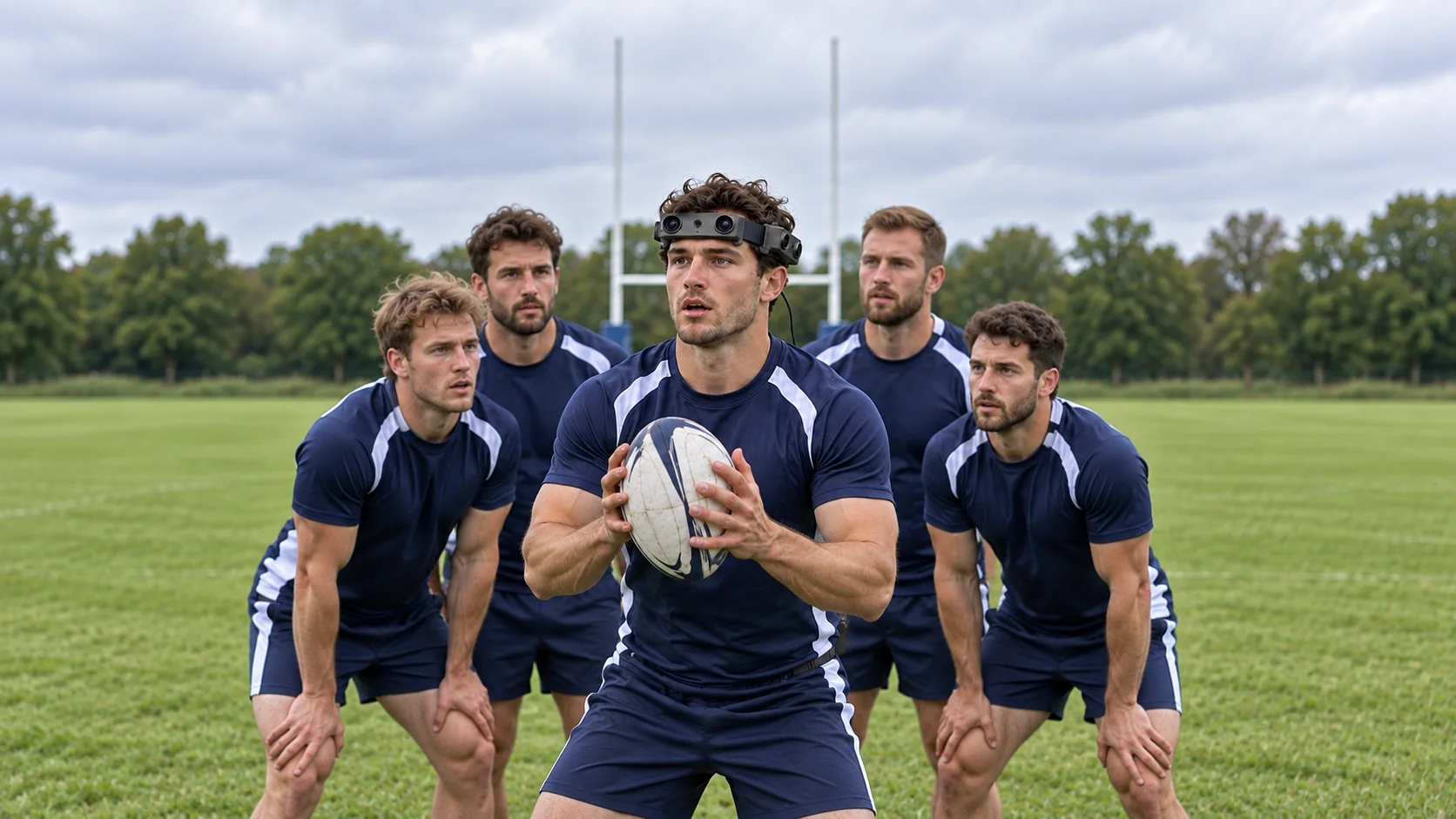
How can R10 support rugby hand–ball interaction research?
- Plan a rugby union catch-and-pass collection around reception, two-handed possession and release.
- Retain corresponding views from one R10 system using its common hardware trigger or shutter signal.
- Review hands and ball at 1600 × 1200 and 30 fps, with framing checked through the fixed-focus lenses.
- Link selected image pairs and camera-pair calibration to researcher-created stage labels and 3D analysis.
A rugby union handling sequence contains several distinct hand–ball relationships: the hands reach towards an incoming pass, take control of the oval ball, reposition it for a pass and release it towards a teammate. EGO R10 offers a head-mounted, multi-camera capture basis for studying these visible transitions. This proposed workflow uses R10 recordings from structured catch-and-pass training to prepare image pairs, action intervals and researcher-created annotations for 3D hand–object interaction research.
Define the rugby handling sequence
World Rugby's receiving guidance describes reaching towards the passer with the hands prepared for the ball. Its linked passing guidance covers two-handed possession, moving the ball across the body and following through towards the receiver. These handling actions give an R10 study a concrete subject: how the two hands are positioned relative to the ball during reception, possession and release. Organize the session around those observable stages and give each recorded repetition a clear start and finish.
Check hand and ball visibility at the recorded resolution
R10 captures 1600 × 1200 images at 30 fps. Begin with a short catch, hold and pass rehearsal while the player wears the headband in the intended position. Review saved images at their original resolution to identify the views containing the left hand, right hand and ball. Inspect the ball outline and the visible fingers before selecting the camera pair and capture position for the collection. Keep the receiving direction and the planned passing direction in the session notes.
The documented R10 lens is fixed focus, with a 180° diagonal, 115° horizontal and 80° vertical field of view. Use the rehearsal to check framing at the actual hand-to-camera distances used in the drill. Repeat that review with the ball held in front of the player and moved into the passing position. Mark which parts of the handling sequence are visible in each selected view; this becomes a practical guide for choosing the frames that enter the research set.
Keep the R10 camera views tied to the same action interval
All cameras in an R10 system are synchronized to a common hardware trigger or shutter signal. During a catch-and-pass repetition, preserve the corresponding recordings from that system together. Assign a take identifier and camera-view identifiers so an analyst can return to the same captured interval in each view. For a visible change such as the ball moving between the hands and the passing position, review the corresponding frames as one observation of that stage.
Record reception and two-handed possession
For reception, begin the selected clip while the player's hands are preparing for the incoming ball and retain the transition into two-handed possession. The research team can mark the first saved frame showing hand–ball contact and a later frame showing the ball under control. Alongside each mark, record which hand surfaces and portions of the ball are visible. R10's 1600 × 1200, 30 fps recordings provide the source images for this review, while the stage labels are entered by the researchers.
Review the transition into a pass
For the passing phase, retain the player's two-handed hold, the movement of the ball across the body and the frames in which it leaves the hands. Use corresponding R10 camera views to examine the same interval. Record the visible ball orientation, the supporting hand positions and the intended receiving side. Where a transition falls between two saved frames, retain both frame identifiers as an interval in the annotation record. This keeps the chosen event definition tied to the recorded evidence.
Prepare image pairs for 3D hand–ball research
R10's documented functions include dual-camera calibration, dual-camera ranging, depth detection and 3D reconstruction. For a hand–ball study, select a camera pair whose trial images contain the relevant hands and ball, and associate the calibration used for the session with those image pairs. The research team defines the visible hand and ball landmarks, documents its reconstruction procedure and checks the resulting 3D representation against the corresponding source images. Keep those research outputs linked to the camera pair, take and selected frame interval.
The oval rugby ball gives the review a concrete object reference. Researchers can note its visible ends, panel pattern and orientation while identifying the hand regions that support it. For each selected R10 image pair, record the visible areas used for annotation and the reviewer's interpretation of the handling stage. Revisit the synchronized source views when checking an annotation, keeping the same stage definitions across repeated catches and passes.
Preserve the recording and session details
R10 provides a USB 2.0 interface and MJPG, H.264 and H.265 output formats. Select the recording format for the collection and check playback before the session. Use the documented DC 5 V external power arrangement, then retain the original video files together with the take index. Record the selected format, image mode and camera-pair calibration alongside the annotations so another member of the research team can locate the same source material.
Build a reviewable rugby interaction collection
A useful rugby research package keeps each complete catch-to-pass sequence together: corresponding R10 camera recordings, the selected image pairs, the calibration used, action-stage intervals and the team's hand–ball annotations. A reviewer can then examine how the visible relationship between the hands and ball changes through one repetition and apply the same review procedure to the next. The organizing unit is the handling sequence recorded by the player-worn R10.
For an EGO R10 evaluation focused on rugby union, describe the intended catch-and-pass drill, the hand and ball views required, the 1600 × 1200 at 30 fps recording mode, the selected output format and the camera-pair calibration needs. A short reviewed pilot can establish the capture arrangement and annotation plan before expanding the collection of rugby handling sequences.
Application source and R10 specifications
World Rugby Passport — receiving the ball and linked handling guidance