
Frontline Data Collection / EGO R9 Field Notes, informed by BLS, OSHA, and Meta AI / Aug 10, 2026
Capturing Expert Hands at Work: Egocentric Data for U.S. Industrial Maintenance
How first-person recordings from industrial machinery mechanics can preserve troubleshooting know-how, build procedural datasets, and support safer AI-assisted training.
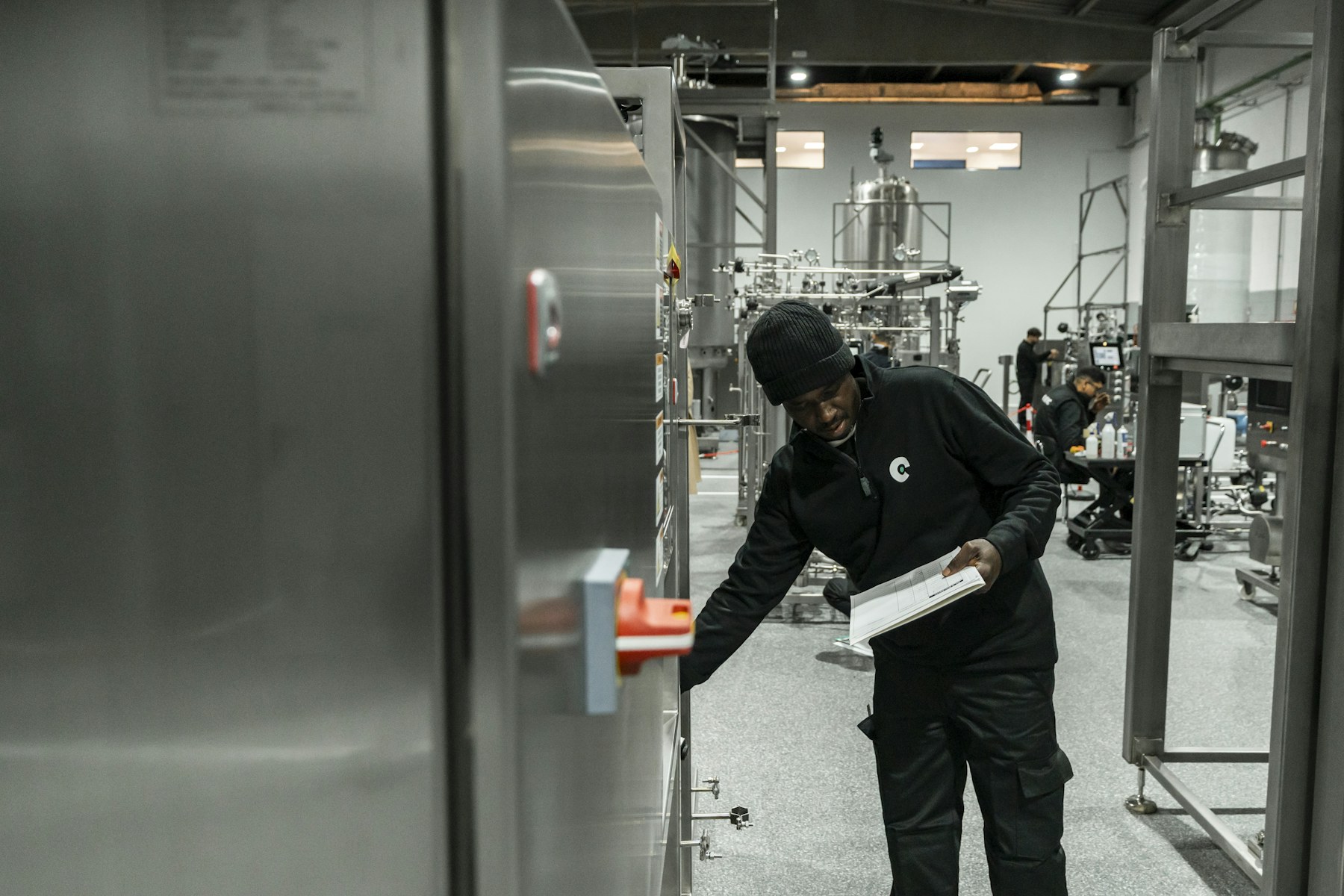
The target participant is a U.S. industrial machinery mechanic, machinery maintenance worker, or millwright—the frontline specialist who keeps conveyors, packaging lines, production equipment, hydraulic systems, and automated machinery operating. The U.S. Bureau of Labor Statistics describes work that includes reading manuals, diagnosing faults, disassembling equipment, replacing components, calibrating machinery, testing repairs, and performing preventive maintenance. These are visually rich, tool-intensive procedures in which expert judgment is often difficult to capture in a checklist alone.
The workforce case is substantial. BLS reported about 538,300 jobs in these occupations in 2024 and projects 13 percent overall employment growth from 2024 to 2034. It also notes that industrial machinery mechanics and maintenance workers commonly need a year or more of on-the-job training. A first-person dataset can help organizations preserve how experienced technicians inspect, sequence, verify, and explain work—especially where retirements, expansion, and increasingly automated equipment put pressure on knowledge transfer.
A useful scenario begins before a wrench turns: review the work order, identify the asset, gather tools and PPE, observe the machine state, consult documentation, and explain the suspected fault. The capture continues through safe isolation, inspection, diagnostic tests, component access, repair or adjustment, reassembly, verification, and a final handoff note. Spoken narration can add why a technician chose one test over another, while timestamped task markers can separate observation, diagnosis, intervention, and validation.
Research provides a clear precedent for recording skilled work from the wearer's viewpoint. Meta's Ego-Exo4D project includes real-world experts such as bike technicians and pairs first-person video with time-aligned inertial signals and language annotations. Its benchmarks study fine-grained procedural steps, proficiency, viewpoint relationships, and hand or body pose.
EGO R9 can be evaluated as the wearable layer of that collection stack. The head-mounted view follows the technician's attention while leaving both hands available for tools. A 120-degree field of view helps retain the relationship among the tool, component, control panel, and surrounding equipment. Global-shutter 1080P video supports moving inspections, while the 6-axis IMU above 200 Hz, shared clock, and global timestamps can align head motion with task events, audio notes, external cameras, or equipment logs.
Potential downstream uses include procedural step recognition, retrieval of similar past repairs, remote expert review, training-video indexing, tool and component detection, hand-object interaction analysis, and robot-learning research around inspection or manipulation. Each use should be evaluated separately.
Safety is the hard boundary. OSHA requires an energy-control program, procedures, employee training, and periodic inspections where servicing could expose workers to unexpected energization, startup, or stored energy. Recording should begin only after the site's qualified safety and operations owners approve the protocol.
For a U.S. pilot, a balanced cohort can include senior mechanics, maintenance technicians, millwrights, and apprentices working on a small set of approved preventive and corrective tasks. The project brief should specify equipment families, safety exclusions, narration rules, metadata, annotation depth, file format, and sample acceptance criteria. That turns an interesting video exercise into an auditable egocentric data program built around real frontline expertise.