
Robot Learning / Human Demonstrations / HumanEgo research / Nov 2, 2026
Wearable Motion Capture Camera: Plant Watering with R9
Use EGO R9 as a wearable motion capture camera to record first-person video and head-unit IMU data for plant-watering robot learning research.
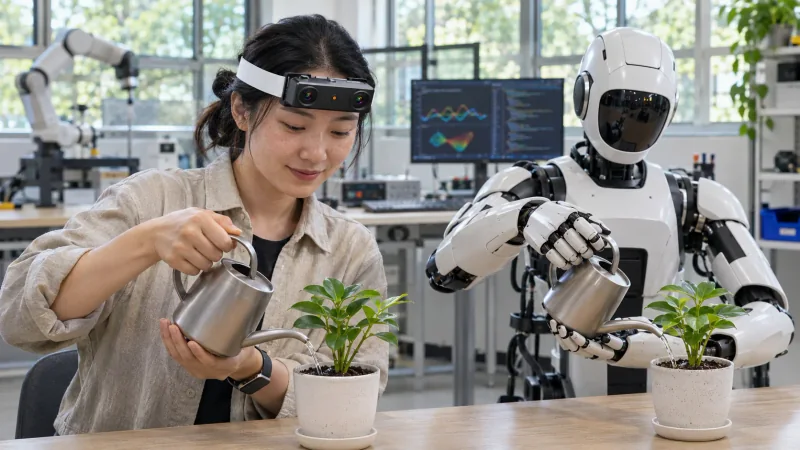
How can R9 capture first-person video and head motion for robot learning?
- Capture first-person video of the watering can, plant and hand movements with the wearable R9 camera.
- Use R9 video and six-axis head-unit IMU timing references to review the same task interval.
- Researchers label the reach, tilt, pour and return phases.
- Organize separate human and robot trials around corresponding task stages.
A wearable motion capture camera can help a research team review what a demonstrator sees and how the worn head unit moves during a task. In this proposed EGO R9 collection, a person waters a small potted plant using a two-handed watering can. R9 provides first-person video, six-axis inertial samples and timing references that researchers can organize as human demonstration data for robot learning around the reach, tilt, pour and return phases.
Research basis for watering demonstrations
The HumanEgo research project presents human egocentric demonstrations and corresponding robot manipulation examples, including watering flowers with both hands. Its research motivates the task described here; the proposed R9 collection and the research project's experiments are separate, and the R9 characteristics below come from its manufacturer specification.
Define a complete plant-watering episode
Set a small potted plant and watering can on a clear work surface. In each take, the wearer reaches for the can, supports and tilts it with both hands, directs the water toward the soil, then brings the can upright. Keep the plant, spout and both hands visible through the full action. The changing can angle and the start and end of the pour give the review team useful visual landmarks.
Frame the working area with R9
R9's documented 120° wide-angle lens and adjustable camera angle help the wearer set up the view for the work position. The manufacturer lists 1080P global-shutter video at 30 frames per second. Review a saved trial around hand contact, the can tilt and the end of the pour, then preserve the selected video and the setup identifier for later inspection.
Review first-person video and head-unit inertial data
The head unit has a six-axis IMU with a specified sampling rate above 200 Hz. Shared-clock and global-timestamp support provide timing references for the video and inertial records. When the wearer looks between the can and plant, researchers can associate the head-unit motion interval with the visual phase they are reviewing. The hands, can and plant are examined in the first-person video.
Organize human demonstration data by task phase
For each demonstration, researchers can record the task identifier, initial position and frame references for grasping the can, beginning the tilt, pouring and returning upright. Use these markers to retrieve the same phase from the saved visual and inertial records. Repeating the task with a different starting position gives the team additional examples to review under separate take identifiers.
Review a corresponding robot task
For a robot-learning study, the team can arrange a separate robot trial with its own plant and watering can, then inspect the robot's tilt and return alongside the corresponding human phases. The accompanying concept illustration shows both actors at a matching stage. The task comparison and any model training are carried out by the research team.
Keep the R9 session records together
R9 supports camera intrinsics, H.265 video in MP4 format and T-Flash card storage. Keep the saved video, available timing and IMU records, supplied camera information and researcher-created phase notes together for each session. This gives the team a traceable record of the watering action and the head-unit motion associated with it.
Research and R9 product references
HumanEgo research — egocentric human and robot demonstrations